
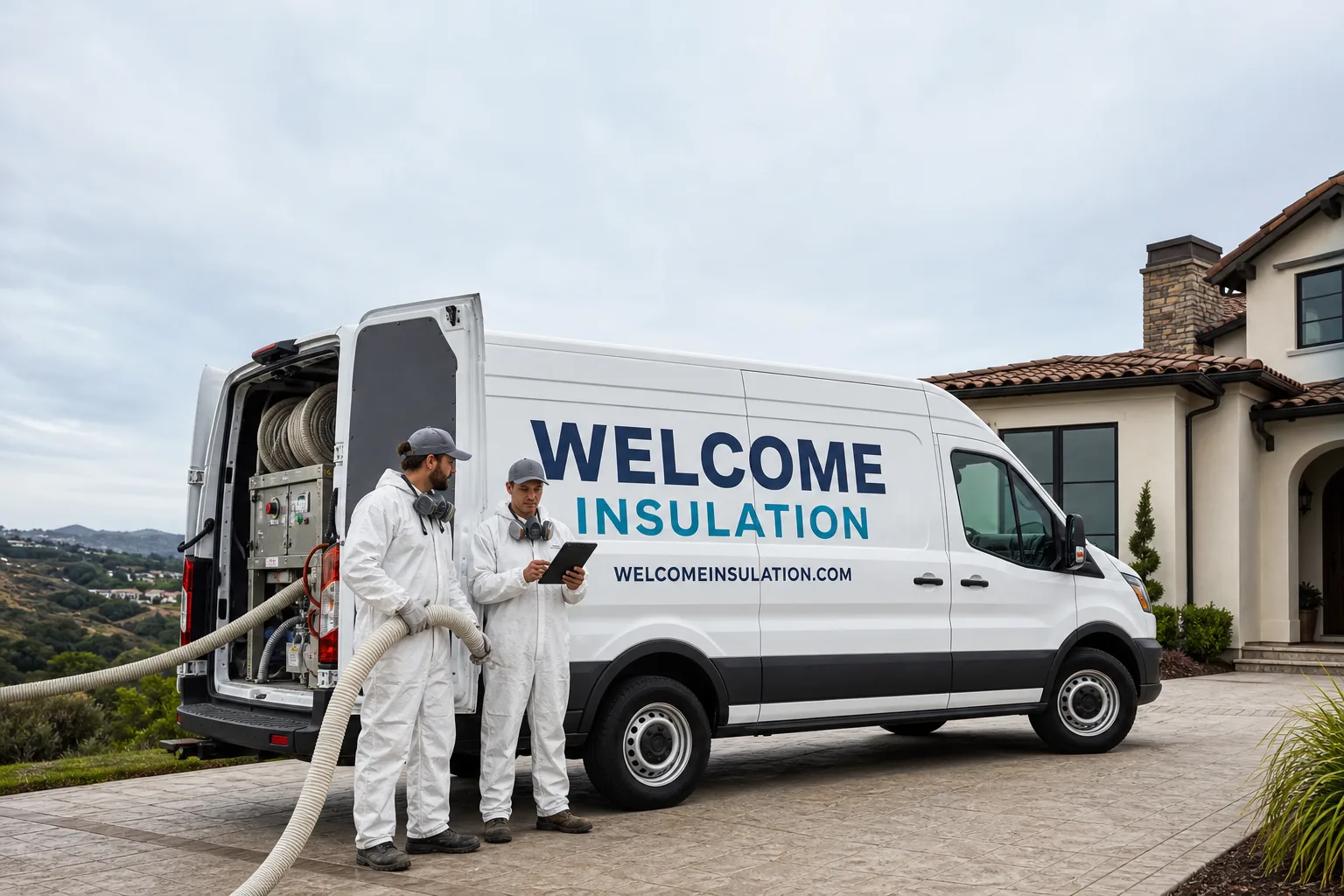
Fast, Reliable Spray Foam Insulation Across Whittier
Spray foam insulation in Whittier typically costs $2,500 to $8,500 for a full attic or wall cavity job, depending on whether you go open-cell or closed-cell. Most Whittier homes we work on fall into a narrower range of $3,200 to $5,800 because we’re usually sealing older 1920s-1950s bungalows rather than new construction. The real challenge in Whittier isn’t just adding R-value. It’s doing it safely inside framing and wiring that was built long before spray foam existed. Call (855) 795-2118 and we’ll give you a straight answer on what your house actually needs.
Our crews know the difference between a 1940s bungalow off Greenleaf and a 1960s tract home in the hills. That matters when the attic has 2×4 rafters, plaster-and-lath walls, and a wiring system nobody has touched in 70 years. If you’re tired of rooms that bake in July and freeze in January, let’s talk about sealing the building envelope properly.
Why Welcome Insulation Is Whittier’s Preferred Spray Foam Insulation Company
Welcome Insulation is an insulation-only specialist serving Whittier. Insulation is all we do. That single-trade focus means every installer who shows up at your door has spent their entire career solving heat loss, air leakage, and moisture problems, not splitting time between drywall, plumbing, and whatever else a general crew happens to have on the schedule. Homeowners tell us they notice the difference in how we explain material choices, and why.
We install both Icynene and Demilec spray foam systems. Ask us why we recommended open-cell over closed-cell for your particular job, and you’ll get a detailed answer tied to your roof deck, your cavity depth, and your wiring. Not a sales pitch. We also stock and install eight major industry brands, including Johns Manville, Knauf, Rockwool, and CertainTeed, across every primary insulation method. The right insulation for your home’s specific needs is our whole operating philosophy.
Our Spray Foam Insulation team has worked on homes throughout Whittier, including the bungalow pockets near Uptown, the Greenleaf corridor, and the stucco tract neighborhoods on the east side. We’re familiar with the local permit office’s expectations for retrofit work and we’re usually on-site within one to two business days of your estimate.
Garage Spray Foam Insulation in Whittier
Garage Spray Foam Insulation in Whittier runs $900 to $2,600 for a typical two-car garage ceiling and shared wall, with most jobs landing around $1,400 to $1,900. In Whittier’s older homes, the garage is often attached, and it’s usually the single biggest hole in the thermal envelope. You feel it in the bedroom directly above the garage, or in a living room that shares a wall with it. We spray closed-cell foam directly to the garage ceiling or shared wall cavity to stop the heat transfer that turns those rooms into ovens by 3 p.m.
Why the Garage-first Approach Works Here
Whittier homes built in the 1940s and 1950s rarely have any separation between the garage and living space. No air barrier. No insulation. Just a sheet of drywall or plaster between you and 130°F garage air in August. Sealing that plane with spray foam has a faster, more noticeable impact than almost any other single retrofit in these houses.
Crew Technique for Older Attached Garages
We inspect the shared wall and ceiling joists before spraying. In many Whittier garages, we find the same knob-and-tube wiring that runs through the rest of the house. We don’t spray against it. We flag it, recommend a wiring check, and only proceed once the cavity is clear. That extra step is what separates a responsible retrofit from a liability.
Closed Cell Spray Foam Insulation in Whittier
Closed Cell Spray Foam Insulation in Whittier costs $3.50 to $6.00 per board foot installed, or roughly $3,800 to $8,500 for a full under-roof application in a typical bungalow. Closed-cell foam is our most common recommendation in Whittier’s shallow 2×4-rafter attics because it delivers high R-value per inch and adds structural rigidity. It’s also the right call for roof deck applications where vent space simply doesn’t exist.
Roof Deck Foam for Shallow Rafter Cavities
Most Uptown and Greenleaf bungalows have 4-inch rafter bays. You can’t stuff fiberglass in there and expect meaningful performance. Closed-cell foam at 3 to 4 inches turns a shallow, unvented attic into a conditioned space. Ductwork stops sitting in 140°F heat. Rooms stay cooler. The foam also seals every gap and crack at the top plates, which is where most of the air leakage actually happens.
Plaster Wall Cavities: What Foam Can and Can’t Do
We’re cautious with closed-cell foam in the plaster-and-lath walls common to 1920s and 1930s Whittier homes. Foam expands as it cures. In a cavity that was never framed for insulation depth, that expansion can crack plaster. We assess cavity depth and wall condition before recommending foam for walls. Sometimes the honest answer is that dense-packed cellulose is the better fit. That’s why we stock GreenFiber alongside our spray foam systems.
Trusted Brands We Service in Whittier
We install Icynene and Demilec spray foam, two of the most widely specified systems in the category. Each has documented R-value performance data, which means you get a paper trail of what was applied and what it’s supposed to do. We also stock Johns Manville, Knauf, Rockwool, and CertainTeed products for jobs where spray foam isn’t the right tool. If a mineral wool sound barrier makes more sense for a shared wall, we’ll tell you that, and we’ll install Rockwool. We install Knauf and CertainTeed for fiberglass applications where budget or vented attic conditions call for it. Insulation is all we do, and we’re not tied to one manufacturer’s product line.
Common Spray Foam Insulation Problems We See in Whittier Homes
- Foam sprayed over live knob-and-tube wiring. In Uptown-area bungalows, we regularly find original wiring stapled through the attic joists. Spray foam traps heat against those old conductors. Any responsible Whittier job starts with a wiring inspection. We won’t spray until the circuit is cleared.
- Roof deck foam without baffles or air sealing on shallow 2×4 rafters. If you choke the only vent path these old attics have, you create a moisture trap. We air-seal top plates and confirm airflow before foam touches the deck.
- Closed-cell foam pushed into shallow plaster wall cavities. Expansion pressure can crack 90-year-old plaster. We measure cavity depth first. In many Whittier walls, the right answer is a different material or a different method entirely.
- Garage ceilings ignored while the rest of the house gets retrofitted. We see this all the time: homeowners insulate the attic but leave a hot garage ceiling bleeding heat into a bedroom above. Sealing the garage plane is often the highest-return upgrade in these homes.
Pricing for Spray Foam Insulation in Whittier, CA
Here’s what homeowners in Whittier can expect based on current market rates. A closed-cell roof deck application on a 900 to 1,200 square foot bungalow runs $3,800 to $6,500. An open-cell attic floor application typically lands between $2,200 and $4,200. A full attached garage ceiling and shared wall runs $1,400 to $1,900. Wall cavity retrofits, where feasible, fall between $4,000 and $8,500 depending on square footage and access. What moves the number: access difficulty in tight 1940s attics, whether we’re reworking existing insulation, and whether wiring remediation is required before we start. Call (855) 795-2118 for a free estimate. We’ll walk the space, show you exactly what’s happening in your attic, and give you a number you can actually plan around.
We Also Serve Cities Near Whittier
Welcome Insulation covers Spray Foam Insulation in Whittier and the surrounding communities. We serve South Whittier, West Whittier-Los Nietos, East La Mirada, and Santa Fe Springs. If you’re a few miles outside city limits, call anyway. We may already be on your street.
Serving Whittier, CA — Our Local Coverage Area
We’re based in the Whittier area and know this community well. Use the map below to see our service coverage — if you’re nearby, we can almost certainly help.
FAQs About Spray Foam Insulation in Whittier
No, not until the wiring is inspected and cleared. Foam traps heat against those old conductors, which is a fire risk. We flag it, recommend an electrician, and schedule the foam once the attic is clear. Call (855) 795-2118 and we’ll walk you through what needs to happen in your specific attic.
Because Whittier’s problem is heat, not deep cold. Summer attics here hit 140°F regularly, and the real enemy is air leakage through top plates, ducts, and old framing. Spray foam air-seals while it insulates. Thick fiberglass in a leaky attic still lets hot air move through it. Sealing first, then layering R-value, is the only approach that actually lowers cooling bills.
It can, if the cavity is too shallow or the plaster is already fragile. Closed-cell foam expands as it cures, and 90-year-old plaster doesn’t flex. We measure cavity depth and inspect wall condition before recommending foam for any wall. In many Whittier bungalows, we recommend dense-packed cellulose or a different approach entirely.
In an attached bungalow or tract home, we usually recommend the garage ceiling and shared wall first. It’s a smaller job with faster payback, and it stops heat from bleeding directly into living space. If your attic is the main problem and you’re cooling 2,000 square feet through 100°F ductwork, the roof deck comes first. We’ll inspect both and tell you which one is hurting you more.
Yes, if you’re keeping the attic vented and only insulating the floor. Baffles preserve the only airflow path these shallow rafter bays have. If we’re doing a full roof deck application with closed-cell foam, the attic becomes unvented by design, and baffles aren’t used. The difference comes down to which plane you’re sealing. Call (855) 795-2118 for a clear diagnosis of your attic layout.
Written by Ruben Ochoa, Owner at Welcome Insulation, serving Whittier and the surrounding communities.