
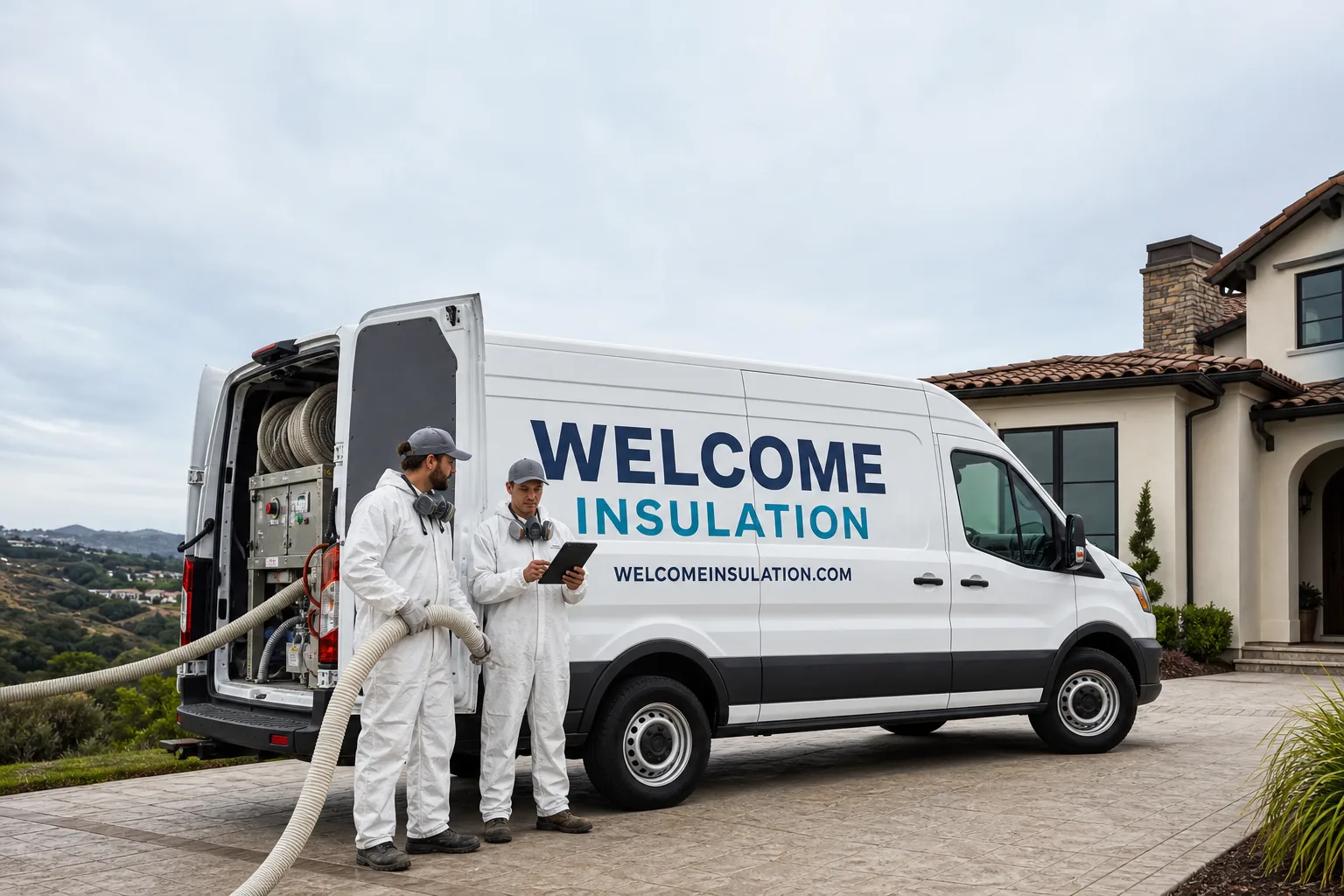
Fast, Reliable Spray Foam Insulation Across Long Beach
If you live in Long Beach and your attic turns into an oven every August while your west-facing rooms stay damp and musty year-round, spray foam is usually the fix, but only if the foam type and install method match your ZIP code. Long Beach spans two very different climate zones within a few miles, and a closed-cell foam spec that makes sense near the 710 can trap moisture against stucco down in Belmont Shore. We’re Welcome Insulation, and insulation is all we do. Our crews work in Long Beach every week, from Naples to Bixby Knolls to North Long Beach, and we’ll give you a straight answer about what your house actually needs. Call (855) 795-2118 for a free estimate.
Why Welcome Insulation Is Long Beach’s Preferred Spray Foam Insulation Company
Long Beach homeowners call us because we don’t show up with a single product and try to make it fit every house. We carry both Icynene and Demilec spray foam systems, which means we can recommend open-cell foam where your walls need to dry inward and closed-cell where you need an air and moisture barrier in one pass. That distinction matters more here than almost anywhere in Southern California, and the local angle matters. Ruben Ochoa and our crews have foamed attics, rim joists, and rooflines in 90802, 90803, 90805, 90810, 90835, and 90840, and we know what a 1928 Spanish bungalow near the beach needs versus a 1959 stucco tract house up by the 91. Insulation is all we do, which means every crew member’s training centers on one trade, not split across roofing, HVAC, and whatever else got scheduled that week.
Our Spray Foam Insulation team spends more time in Long Beach attics than most contractors spend in their own garages. When you call, you’ll talk to someone who has actually walked through homes in your neighborhood, not a call center reading a script.
Spray Foam Insulation Contractors in Long Beach
Spray Foam Insulation Contractors in Long Beach work on a housing stock that most inland cities don’t have. Long Beach mixes 1920s and 1930s California bungalows and Spanish stucco homes near downtown and Belmont Shore with thousands of post-WWII 1950s and 1960s tract houses and stucco duplexes across the north and east sides. What that means for spray foam: older walls often have no cavity insulation at all, and newer ones have settled fiberglass batts that stopped doing their job years ago. A typical rim joist spray foam job in Long Beach runs $1,400 to $2,800 for an average home, while a full attic roofline application usually lands between $3,200 and $6,500 depending on square footage and whether we’re air-sealing first.
Open-Cell vs. Closed-Cell for Coastal Walls
In shore-adjacent ZIPs like 90803, we typically specify open-cell foam with an intumescent coating or a smart vapor retarder. The reason is simple: your stucco walls need a drying path. Closed-cell foam applied directly to the back of stucco creates a double vapor barrier, and we’ve seen the result: blistered stucco, wet framing, and musty rooms that never quite dry out. Open-cell lets the wall assembly breathe inward.
Rim Joist and Garage Ceiling Work
Long Beach rim joists, especially in raised-foundation bungalows near the water, leak conditioned air and let damp crawlspace air migrate up into living space. We seal them with closed-cell foam as an air and vapor barrier. Garage ceiling applications under bonus rooms are also common in the city’s many converted single-car garages, where noise and heat transfer between the garage and the room above are the complaints that drive the call.
Spray Foam Attic Insulation in Long Beach
Spray Foam Attic Insulation in Long Beach is most effective when it’s paired with air-sealing and a ventilation strategy matched to your neighborhood. Attic temperatures in inland Long Beach ZIPs like 90805 and 90810 routinely hit 140°F on summer afternoons, which is why cooling-load insulation matters more there than heating. In 90802 and 90803, the priority flips: the marine layer keeps things mild and humid, so the real enemy is condensation, damp batts, and the cool air that seeps through every unsealed top plate. A typical attic spray foam project in Long Beach runs $4,500 to $9,500 for a full roofline unvented assembly, and $2,000 to $4,200 for targeted air-sealing plus partial foam in a vented attic.
Roofline Foam on Older Spanish and Craftsman Homes
We recently foamed the attic roofline of a 1928 Spanish bungalow on Granada Avenue in Belmont Shore. The original kraft paper facing had disintegrated from decades of marine humidity, leaving bare batts that had slumped and were trapping damp against the stucco. We air-sealed the top plates and applied 5.5 inches of open-cell spray foam to the roof deck, then added a small dehumidifier to manage the coastal humidity. The homeowners reported the back bedroom finally felt dry and the afternoon sun on the west wall no longer baked the room.
Vented Attics in 1950s Tract Homes
In the city’s many 1950s stucco tract houses, foaming the attic ceiling without first air-sealing and confirming ventilation can push moisture into the living space and worsen musty odors. We address that by sealing every penetration before foam goes in: top plates, can-light housings, bath fans, and the gap around the chimney chase. If the attic has old knob-and-tube wiring, which is common in pre-1940 bungalows, we require that wiring be either rerouted or properly protected before any foam touches the framing. Foam over active knob-and-tube creates a serious fire risk and fails code.
Trusted Brands We Service in Long Beach
We install Icynene and Demilec spray foam systems because both are widely specified in the spray foam category, with documented R-value performance data you can look up. For jobs where spray foam isn’t the right call, we also work with Johns Manville, Knauf, Rockwool, and CertainTeed, and we’ll tell you why we recommended one material over another. Long Beach homeowners appreciate that we stock materials locally and can usually schedule within a week, with faster turnaround for emergency rim joist or garage ceiling work. Ask us why we specified open-cell Icynene over closed-cell Demilec on a shore bungalow, and Ruben will explain the vapor path in plain English.
Common Spray Foam Insulation Problems We See in Long Beach Homes
- Closed-cell foam against stucco in shore ZIPs. In 90802 and 90803, we routinely see closed-cell foam applied directly to the back of stucco. That traps condensation, blisters the stucco, and keeps the wood framing wet. The fix is open-cell with a smart vapor retarder so the wall can dry inward.
- Degraded kraft paper and aluminum foil in pre-1940 attics. On older Long Beach bungalows, especially in the shore ZIPs, technicians find wall cavities with no insulation at all and foil or kraft paper that has degraded from decades of marine humidity. Adding blown-in or sprayed insulation without air-sealing and ventilation first traps moisture against the stucco and makes it worse.
- Spray foam over knob-and-tube wiring. Pre-1940 homes near downtown and in the historic districts often still have active knob-and-tube. Foam sprayed over it is a code violation and a fire hazard. Any reputable installer in Long Beach will flag this before touching the gun.
- Unsealed attics in 1950s tract homes that smell musty. North and east Long Beach tract houses built in the 1950s and 1960s often have no attic air-sealing. When foam goes in without sealing top plates and penetrations first, moisture pushes into the living space and the musty smell gets stronger, not weaker.
Pricing for Spray Foam Insulation in Long Beach, CA
Long Beach spray foam pricing runs higher than the Southern California average on shore-side jobs because access is tighter and the moisture-control prep is more involved. Here’s what you can expect: rim joist spray foam runs $1,400 to $2,800 for a typical raised foundation home. Garage ceiling spray foam under a bedroom runs $1,800 to $3,600. Attic roofline open-cell foam runs $4,500 to $9,500 for a full unvented assembly, and partial attic air-sealing with foam at the top plates and penetrations runs $2,000 to $4,200. Closed-cell foam runs 30% to 40% higher per board foot than open-cell. Every estimate is free, and we give you the exact number before any work starts. Call (855) 795-2118 and Ruben will walk the job with you.
We Also Serve Cities Near Long Beach
Welcome Insulation works throughout the South Bay and Harbor area. You’ll find our crews in Long Beach weekly, and we regularly take calls from Signal Hill, Lakewood, Carson, and West Carson homeowners who want the same ZIP-specific material matching we provide in Long Beach. Same response time, same eight-brand material roster, no general contractor markup.
Serving Long Beach, CA — Our Local Coverage Area
We’re based in the Long Beach area and know this community well. Use the map below to see our service coverage — if you’re nearby, we can almost certainly help.
FAQs About Spray Foam Insulation in Long Beach
Coastal ZIPs like 90803 sit under the marine layer most mornings, so humidity stays high and walls stay damp. Closed-cell foam against stucco in that environment traps moisture against the wall assembly, causing the stucco to blister and framing to stay wet. Inland 90805 gets afternoon heat and dry air, where closed-cell works fine as an air and vapor barrier. That’s why we spec open-cell with a smart vapor retarder on the coast and lean closed-cell inland. Call (855) 795-2118 and we’ll check your specific ZIP and wall assembly before recommending anything.
No, you shouldn’t spray foam over degraded kraft paper or aluminum foil. In 1930s Long Beach bungalows, that paper has usually failed from decades of marine humidity, and spraying over it traps moisture against the stucco and the framing. The right sequence is to remove or bypass the old facing, air-seal the cavity, and then apply the appropriate foam type for your wall assembly. We’ll tell you exactly what we found when we open the wall, before any foam goes in.
For a 1950s stucco tract home in Long Beach, we typically recommend R-38 to R-49 in the attic for inland ZIPs and R-30 to R-38 in the attic for shore ZIPs where the priority is moisture control rather than extreme heat. For open-cell spray foam on the roofline, 5.5 inches gives you about R-20 to R-21, which meets code for unvented attics in this climate zone when combined with proper air-sealing. The exact number depends on your specific house, and we’ll show you the R-value math on the estimate.
For Long Beach duplexes and fourplexes where noise between units is the main complaint, we typically use open-cell spray foam on the shared wall cavities and the rim joist. Open-cell is better for sound attenuation than closed-cell, and it’s also more forgiving on older framing. For floor-ceiling assemblies between units, closed-cell on the rim joist plus open-cell in the floor cavity gives you both air-sealing and sound control. Most Long Beach multi-family jobs run $2,800 to $6,000 per unit depending on the size and the number of shared surfaces.
Yes, in most 1920s Long Beach homes the old insulation has to come out before foam goes in. The original batts or blown-in material is usually degraded from humidity, may contain rodent droppings, and if the house is pre-1940 there may be knob-and-tube wiring underneath that needs to be addressed first. We’ll remove the old material, inspect the cavities, confirm the wiring situation, and then foam. We never spray over old insulation or active knob-and-tube, and we’ll walk you through what we find with photos before proceeding.
If you’re tired of fighting damp walls, hot attics, and energy bills that don’t match the thermostat setting, call Welcome Insulation at (855) 795-2118. Ruben Ochoa and our Long Beach crews will give you a straight answer, a free estimate, and a foam spec that matches your ZIP code, your wall assembly, and your budget.
Written by Ruben Ochoa, Owner at Welcome Insulation, serving Long Beach and the South Bay.