
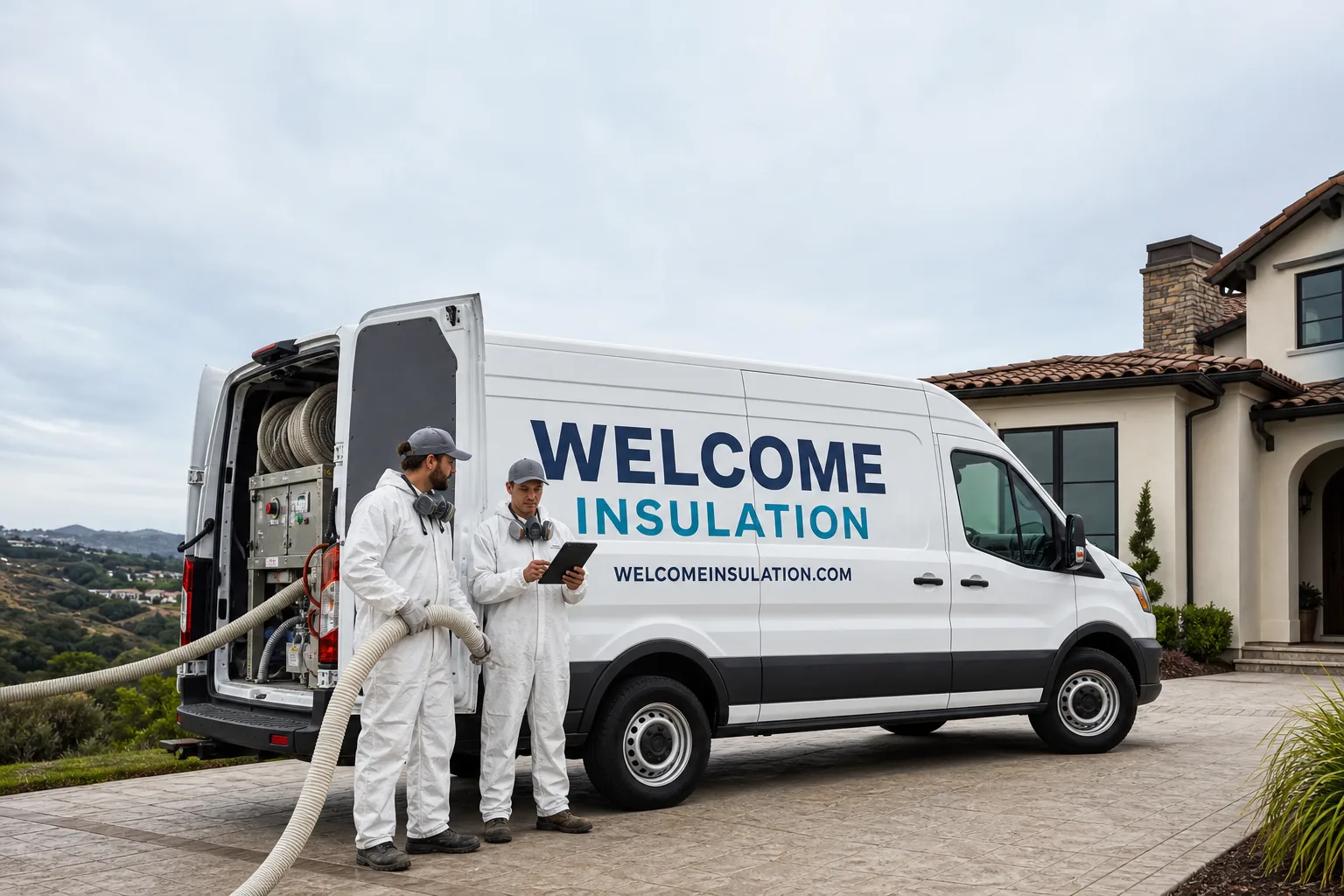
Fast, Reliable Attic Insulation Across Rolling Hills Estates
Attic insulation in Rolling Hills Estates is a different job than it is down the hill. On the Palos Verdes Peninsula, the marine layer rolls in most mornings and evenings, saturating attics with damp salt air that never fully burns off. That means the right insulation here has to do two jobs: hold R-value and manage moisture. We’re Welcome Insulation, and insulation is all we do. Our team works throughout the 90505 zip code, from the ranch homes off Palos Verdes Drive North to the split-levels near Rolling Hills Country Club. Call (855) 795-2118 for a free estimate and we’ll come out, inspect your attic, and tell you straight what’s needed.
Why Welcome Insulation Is Rolling Hills Estates’s Preferred Attic Insulation Company
Homeowners in Rolling Hills Estates call us because they want a specialist, not a general contractor who does insulation on the side. Our installers work exclusively with attic insulation, blown-in, and spray foam systems. That focus means we’ve seen the specific failure patterns that show up in mid-century peninsula homes: compressed fiberglass from roof leaks, dark staining near attic hatches, and mold blooms that start where the fog keeps surfaces damp. We know the difference between a home off Crenshaw Boulevard that needs a simple top-up and a hillside property off Palos Verdes Drive East where moisture management is the real issue. Ruben Ochoa, our owner, has built the company around matching materials to conditions rather than selling whatever is in stock at the warehouse.
Our response time to Rolling Hills Estates is usually same-day or next-day for inspections. We keep crews working across the peninsula weekly, so we’re already close by when your attic starts showing signs of trouble. And while we don’t print review counts on our pages, we can tell you that most of our Rolling Hills Estates customers come from referrals. Neighbors talk about who fixed their musty attic for good.
Insulation Contractors in Rolling Hills Estates
Insulation Contractors in Rolling Hills Estates work on homes that are mostly 50 to 70 years old, which changes how we approach every job. The original insulation in these 1950s to 1970s ranch and split-level houses was often a thin layer of fiberglass batts laid between ceiling joists. Decades of marine-layer humidity and the occasional slow roof leak have compressed that insulation, cutting its effective R-value by half or more. When we open an attic off Palos Verdes Drive North, the first thing we look for is whether the existing material is still dry. If it’s wet, adding new insulation on top just traps the problem underneath. The job involves removing the failed material, sealing the attic floor against air leakage, and installing insulation that’s matched to the house’s age and the coastal conditions. A full removal and re-insulation in Rolling Hills Estates typically runs $1,800 to $4,200, depending on attic size and access.
Attic Floor Air Sealing
Before any new insulation goes in, we seal penetration points where humid air migrates from the living space into the attic. This includes can light housings, ceiling fan boxes, and the gaps where interior walls meet the attic floor. In a peninsula home, this step matters more than it would in Torrance, because the air moving up from your house is carrying moisture that will condense on the underside of your cold roof sheathing.
Moisture Assessment First
We won’t quote an R-value upgrade until we’ve checked for moisture intrusion. On Rolling Hills Estates hillsides, roof leaks that start at flashing points or ridge vents can stay hidden for years, slowly saturating the insulation from above. If we find dampness, the fix has to start there, not with the insulation. That’s why every job begins with an inspection, not a bid.
Attic Ventilation in Rolling Hills Estates
Attic Ventilation in Rolling Hills Estates is the difference between insulation that performs for decades and insulation that rots out in five years. The marine layer here brings in fog that settles on roof surfaces and finds its way through ridge vents, soffit gaps, and old gable vents. Without enough airflow, that moisture condenses on the underside of the sheathing and drips down onto whatever insulation is below. Proper ventilation moves that wet air out before it can do damage. We install soffit vents, baffles, and ridge vent systems designed for coastal homes. A typical ventilation upgrade on a Rolling Hills Estates attic runs $850 to $1,900, depending on the roof’s geometry and how much venting already exists. Most older peninsula homes were built with minimal airflow, so this work is usually necessary before or alongside new insulation.
Baffle Installation for Soffit Vents
Older Rolling Hills Estates homes often have soffit vents that are blocked by insulation shoved up against the roofline. We install baffles to keep that air path open, which prevents the attic from becoming a humid, stagnant box during fog season. This is a small job with a big impact on insulation lifespan.
Marine-Layer Venting Upgrade
When a home sits high on a hillside off Palos Verdes Drive East and gets direct fog exposure, we often recommend increasing the net free vent area beyond minimum code. More airflow means less trapped moisture. Our crews calculate vent ratios for the specific roof configuration and prevailing wind patterns on your side of the peninsula.
Trusted Brands We Service in Rolling Hills Estates
We stock and install insulation from manufacturers that publish real performance data, so you can verify the R-value you’re paying for. For Rolling Hills Estates attics, we frequently recommend Rockwool mineral wool because it resists moisture, holds its shape even if it gets damp, and carries a strong fire rating. Owens Corning fiberglass batts are a solid choice when the attic stays dry and the homeowner wants maximum R-value per dollar. And Johns Manville products work well for top-up projects where the existing insulation is still in fair condition. These aren’t budget private-label products. They’re brands with a documented paper trail, which matters when you’re spending real money on a retrofit. We keep local inventory organized for quick turnaround on Rolling Hills Estates jobs.
Common Attic Insulation Problems We See in Rolling Hills Estates Homes
- Saturated batts from fog-driven condensation: The marine layer pushes moisture into attics through poorly sealed hatches and under-ventilated eaves. Over time, fiberglass batts absorb that dampness and lose up to half their R-value while trapping moisture against wood framing.
- Builder-grade attic hatches that leak humid air: Mid-century peninsula homes came with flimsy plywood hatch covers and no weatherstripping. The gap around the hatch acts like a permanent open window from the living space into the attic.
- Compressed original insulation on hillside properties: Roof leaks that go unnoticed for years compact fiberglass batts down to a fraction of their original depth. We have pulled out batts that looked like damp newspaper, with an R-value closer to R-6 than the R-30 they started with.
- Detached garage and barn attics left uninsulated entirely: Rolling Hills Estates has more horse properties and estate lots than most of the South Bay. Those detached structures often have no insulation at all, so we treat them as separate projects with their own moisture and ventilation needs.
Pricing for Attic Insulation in Rolling Hills Estates, CA
A typical attic insulation top-up in Rolling Hills Estates runs $1,200 to $2,600, depending on the square footage and the condition of the existing material. Full replacement, which includes removal of failed insulation, air sealing, and new batts or blown-in material, lands between $2,400 and $5,500 for most peninsula homes. Adding ventilation work brings the total to $3,200 to $7,400. What moves the number? Attic access, the amount of old material that has to come out, whether we’re dealing with vaulted ceilings, and whether a crawlspace or detached structure is involved. We give exact quotes before starting, not after. Call (855) 795-2118 and we’ll schedule a free inspection and give you a written estimate for your specific house.
We Also Serve Cities Near Rolling Hills Estates
If you’re one neighborhood over, we have you covered too. Our Attic Insulation team is working every week in Torrance, Lomita, West Carson, and Carson. The coastal moisture issues on the peninsula ease off as you move inland, but the housing stock and retrofit needs are similar. Learn more about our broader service area on our Rolling Hills Estates page.
Serving Rolling Hills Estates, CA — Our Local Coverage Area
We’re based in the Rolling Hills Estates area and know this community well. Use the map below to see our service coverage — if you’re nearby, we can almost certainly help.
FAQs About Attic Insulation in Rolling Hills Estates
Rolling Hills Estates sits in the path of the marine layer, which pushes salt-laden fog up over the peninsula almost every evening. That persistent dampness infiltrates attics through vents, hatches, and roof gaps, condensing on the underside of sheathing and soaking into insulation. Inland cities like Torrance or Carson get the same coastal influence but less fog exposure, so their attics stay drier. The result is that peninsula insulation fails from moisture saturation, not heat degradation, which is why we prioritize vapor barriers and ventilation as much as R-value. Call (855) 795-2118 for an attic inspection specific to your home’s fog exposure.
Yes, in most cases the vaulted ceiling stays intact. We work from the attic side, cutting access points or using existing hatch openings to pull failed batts and blow in new material. If the vaulted section has no accessible attic cavity above it, we use a different approach: injecting dense-pack cellulose or foam into the rafter bays. We have done this on many ranch homes off Palos Verdes Drive North without touching the interior finish. Call (855) 795-2118 to have us look at your specific ceiling construction.
For Rolling Hills Estates attics, we most often install Rockwool mineral wool because it resists moisture absorption and maintains its R-value even if it gets damp. Owens Corning and Johns Manville fiberglass products are also available for attics that stay dry and just need more thermal resistance. We’ll explain why one material fits your attic better than another based on what we find during inspection. Call (855) 795-2118 and ask us why we recommended what we recommended.
Yes, they’re separate structures with their own thermal and moisture profiles, and they usually have zero insulation. Detached garages and barns on peninsula estate lots are exposed to the same marine-layer dampness as the main house but often lack any venting or vapor management. We treat each outbuilding as its own project, with its own material recommendation. Call (855) 795-2118 if you want the outbuildings on your property included in the estimate.
The first step is removing anything that’s already wet or moldy, because leaving it in place guarantees the problem returns. Then we seal the attic floor and hatches to stop humid air from migrating up from the living space. We install vapor barriers where needed, add ventilation to move fog-season moisture out, and only then place the new insulation. On a 1960s ranch off Palos Verdes Drive East, we removed original fiberglass batts saturated from a hidden roof leak, treated the mold, sealed the attic floor, and installed Rockwool with a vapor barrier plus added ventilation. The homeowner noticed the musty smell was gone within a week. Call (855) 795-2118 to have us check your attic for the same issue.
Written by Ruben Ochoa, Owner at Welcome Insulation, serving Rolling Hills Estates and the Palos Verdes Peninsula.