
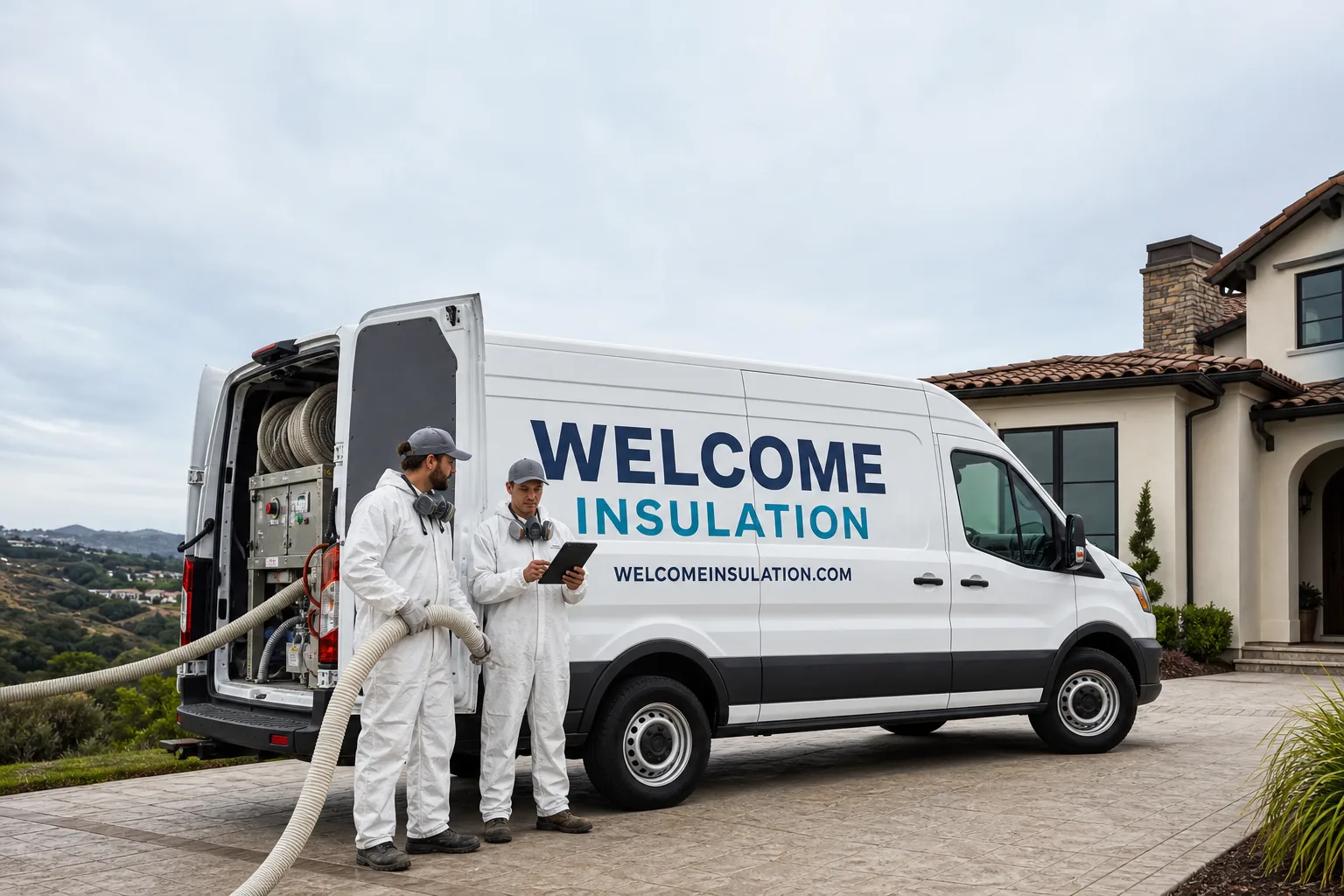
Fast, Reliable Attic Insulation Across Downey
Attic insulation in Downey is, for most homes here, a retrofit job on a 1950s or 1960s single-story stucco tract house with a low-pitch roof and shallow eave vents. We know that because we’ve worked the 90240, 90241, and 90242 zip codes long enough to recognize the framing before we climb the ladder. When a Downey homeowner calls us about a hot back bedroom in August or a heat pump that won’t cycle off, we know exactly what’s in that attic before we open the hatch: settled mineral wool, blocked eave vents, or nothing at all. Call us at (855) 795-2118 for a straight answer and a free estimate.
Why Welcome Insulation Is Downey’s Preferred Attic Insulation Company
Insulation is all we do. Our crew doesn’t split time between roofing, plumbing, or HVAC callbacks. Every installer on a Downey job has spent their field hours thinking about one trade: how air moves through a house envelope, and how to stop it from moving the wrong way. That single-trade focus matters in a city like Downey, where most work is retrofit into tight, awkward cavities rather than clean new construction. Ruben Ochoa runs the team with a simple rule: if the baffle doesn’t fit the rafter bay, you cut a new one. You don’t stuff fiberglass over a blocked vent and call it done.
Downey homeowners regularly tell us the same thing: the previous quote they got came from a general contractor who handed them a single material option and a price. We show up with eight manufacturer brands across three installation methods, and we recommend the product that matches the house, the roof pitch, the venting, and the homeowner’s actual goal. Sometimes that’s Owens Corning blown-in fiberglass to R-38. Sometimes it’s Rockwool batts for fire resistance and sound control up against a shared wall or a busy street like Firestone Boulevard. The job dictates the material, not the other way around.
Insulation Contractors in Downey
Insulation Contractors in Downey operate in a particular kind of housing stock: wood-frame stucco tracts built between 1955 and 1965, with plaster walls, low-pitch roofs, and original attics that ranged from R-0 to maybe R-11. That means the contractor you hire needs to think in terms of air sealing, baffle placement, and retrofit access, not just blowing product into a cavity. A typical attic insulation job in Downey runs $1,900 to $3,600 for a standard 1,000 to 1,400 square foot home, depending on existing material, access, and whether we’re topping up or starting from bare gypsum.
Retrofit Attic Access
Most Downey homes have a small interior hatch, often in a hallway closet, measuring 22 inches square or less. We remove old material, air-seal the top plates and penetrations, install baffles, and blow to target depth. Dense-pack wall work through the stucco exterior is a standard method for homes from this era, and we handle it without gutting the interior.
Blown-In and Batt Work for Postwar Tracts
Blown-in fiberglass and cellulose are the workhorse products for shallow, hard-to-reach Downey attics. Batt insulation still makes sense for accessible rafter bays, especially where homeowners want a clean surface to walk on for storage. We’ll tell you which one fits your roof before we quote, and we’ll explain why.
Attic Ventilation in Downey
Attic Ventilation in Downey is not a nice-to-have add-on. It’s the difference between an attic that breathes and an attic that bakes. Downey’s inland Los Angeles basin climate gives us hot, dry summers with an August attic temperature that can exceed 140°F when the eave vents are blocked. The classic local failure is blown insulation covering the shallow eave vents on a low-pitch roof, which traps heat and radiates it down through the ceiling into the back bedrooms. Proper baffles and venting fix that. A ventilation correction runs $450 to $1,200 on most Downey homes, and it’s often the single highest-value upgrade for comfort and for a heat pump’s efficiency.
Shallow Eave Vent Baffles
On a 1958 tract home near Rancho Los Amigos, our crew found the original mineral wool had settled to R-5 and was blocking the eave vents, baking the back bedrooms. We installed Owens Corning blown-in fiberglass to R-38, added GreenFiber loose-fill in the walls, and set rigid foam baffles at every rafter bay to restore airflow. The homeowner reported a 12°F drop in attic temperature by afternoon, and the new heat pump finally cycled normally.
Whole-Attic Airflow Correction
Many Downey attics were built with eave vents only, no ridge vent or gable vent, because the original construction assumed the house would leak enough air on its own. Once you air-seal and insulate, that math changes. We correct the airflow path so the insulation performs as designed and the roof deck doesn’t cook from the underside.
Trusted Brands We Service in Downey
We stock and install products from Johns Manville, Knauf, and Rockwool, along with Owens Corning, CertainTeed, Icynene, Demilec, and GreenFiber. For a Downey homeowner, that means we’re not married to one manufacturer’s spec sheet. We recommend Rockwool when fire resistance and sound control matter, like a home on a busy corridor near Paramount Boulevard. We recommend Johns Manville blown-in fiberglass for fast, even coverage in a tight attic, and Knauf batts for straightforward rafter-bay work. Ask us why we recommended one material over another. We’ll give you a concrete answer tied to your house, not a brochure paragraph.
Common Attic Insulation Problems We See in Downey Homes
- Blocked eave vents on low-pitch roofs: Downey’s postwar tracts were built with shallow eave vents, often under three inches of clearance. Blown insulation covers them easily, and the attic bakes in August. We cut and set baffles at every rafter bay before blowing.
- Settled original mineral wool: Sixty-year-old mineral wool compacts to a fraction of its original R-value, leaving gaps behind knee walls and over top plates. We remove or top it up, and we test the result with a thermal check before we leave.
- Wall cavities with no insulation at all: Many Downey stucco homes have bare 2×4 wall cavities with nothing between the sheathing and the plaster. Dense-pack drilling through the stucco is the standard fix, and it doesn’t require tearing out walls.
- Alley-load access and tight parking: A surprising number of Downey homes have no driveway, just an alley gate and street parking. That forces long equipment carries and can tempt crews to skip air sealing around top plates. Our staging accounts for it, and we don’t cut corners when the hose is long.
Pricing for Attic Insulation in Downey, CA
You should not hire an insulation contractor without real numbers. A standard attic top-up in Downey, going from R-5 or R-10 to R-38 with blown-in fiberglass, runs $1,400 to $2,200 for a typical 1,100 square foot home. Full removal and replacement runs $1,900 to $3,600. Wall dense-packing adds $3,500 to $6,000 depending on exterior access and cladding. Attic ventilation corrections, including baffles, run $450 to $1,200. You can call (855) 795-2118 for a free estimate. We measure, we give you a fixed number based on your attic, and we don’t push you toward a material we wouldn’t put in our own houses.
We Also Serve Cities Near Downey
Welcome Insulation works throughout Southeast Los Angeles County, including Bell Gardens, Santa Fe Springs, Paramount, and Pico Rivera. Our Attic Insulation crew handles the same postwar tract homes and retrofit access issues in those cities as we do in Downey. If you’re on the edge of town or just over the city line, call and we’ll confirm coverage.
Serving Downey, CA — Our Local Coverage Area
We’re based in the Downey area and know this community well. Use the map below to see our service coverage — if you’re nearby, we can almost certainly help.
FAQs About Attic Insulation in Downey
Yes. We stage equipment at the alley gate and carry hoses through the yard or the house interior, whichever is cleaner and faster. We’ve done this on dozens of Downey homes, particularly in the older tracts north of Firestone Boulevard where alley loads are standard. We plan for the access before we arrive, and we charge the same rate for the job regardless of the carry distance. Call (855) 795-2118 and we’ll schedule a site walk to confirm staging.
Yes, if the installer doesn’t set baffles first. Downey’s low-pitch roofs leave very little vertical room at the eave, and blown fiberglass or cellulose will cover a shallow vent channel quickly. We install rigid foam baffles at every rafter bay before we blow, which keeps the airflow path open and the attic temperature stable. If your current attic already has blocked vents, we can remove the material, correct the baffles, and re-blow to the right depth.
R-38 is the standard recommendation for a Downey attic, even though our climate is mild by national standards. The driver here is summer attic heat gain and radiant heat from the roof deck, not winter heating. R-38 with proper venting and air sealing keeps the ceiling temperature stable and lets a heat pump run far more efficiently. Some homeowners with existing R-30 and good venting can stay put, but if we’re in your attic anyway, topping up to R-38 is usually worth it.
Yes. We correct under-vented attics by adding or repairing eave baffles, upgrading soffit vents, and where the roof design allows, adding passive ridge or gable venting. On Downey’s original low-pitch roofs, the biggest win is usually restoring the existing eave vent path rather than cutting new holes. We inspect first, tell you what’s actually restricted, and quote only the work that will move air.
Yes, through dense-pack drilling. We drill small access holes through the stucco or sheathing, blow the cavity full and firm with GreenFiber cellulose or another approved material, then patch and finish to match. This is the standard method for Downey’s uninsulated postwar wall cavities, and it doesn’t require removing plaster or interior drywall. Most two-to-three bedroom homes can be done in a day. Call (855) 795-2118 and we’ll walk you through the process for your specific house.
Written by Ruben Ochoa, Owner at Welcome Insulation, serving Downey and Southeast Los Angeles County.