
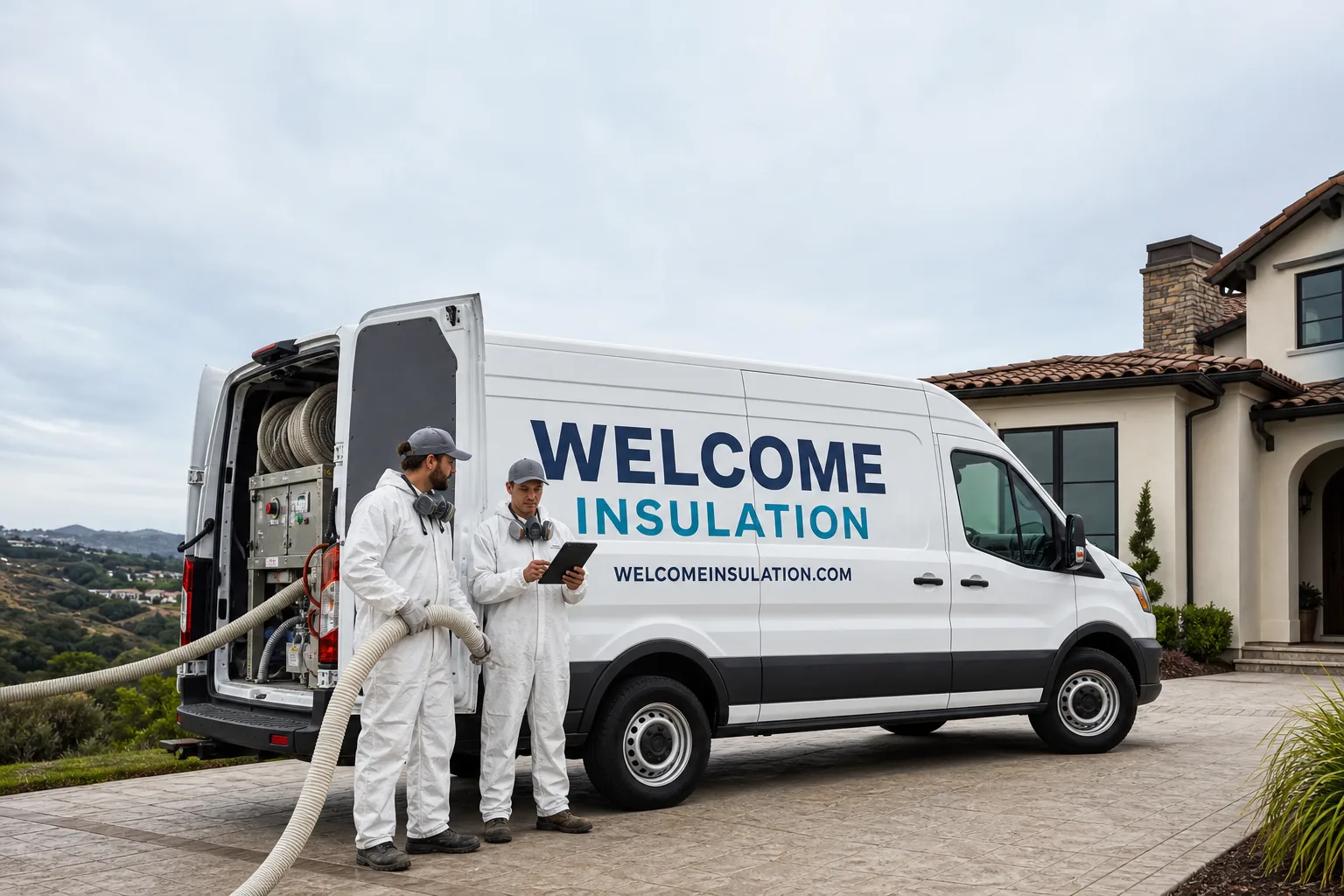
Fast, Reliable Spray Foam Insulation Across Santa Fe Springs
Spray foam insulation in Santa Fe Springs is a different animal than what you’ll find in Downey or Pico Rivera. Here, the work skews industrial. The Whittier Boulevard corridor, the tilt-up warehouses near Heritage Park, the metal-clad manufacturing buildings off Norwalk Boulevard: these are the structures that drive most spray foam demand in this city. When a 1960s warehouse roof deck pushes summer interior temps past 130°F, or a 1970s tract home near Telegraph Road has settled blown insulation that stopped working a decade ago, we’re the crew that shows up with both Icynene and Demilec systems on the truck and a real answer for the heat load. We know this city’s building stock because we’ve foamed it. More on our Spray Foam Insulation work, or keep reading for what matters in Santa Fe Springs specifically. Ready to talk now? Call (855) 795-2118.
Why Welcome Insulation Is Santa Fe Springs’s Preferred Spray Foam Insulation Company
Insulation is all we do, and in a city where the insulation problem is often a 20,000-square-foot tilt-up with an uninsulated metal deck rather than a 1,100-square-foot attic, that focus matters. Ruben Ochoa leads our crew, and he’s spent years mapping the specific failure points in Santa Fe Springs buildings: oil-contaminated decking on old manufacturing floors, dusty attic cavities in 1950s tract homes, parapet details on red-tile low-slope industrial roofs that leak air like a sieve. General contractors who rotate between framing, drywall, and insulation don’t build that kind of local-specific knowledge. We do.
Our Santa Fe Springs customers call us for two reasons: we show up with the right material for the job, and we explain why. When a homeowner on a quiet residential street off Lakeland Road asks whether open-cell or closed-cell foam belongs in their garage ceiling, we give them a straight answer about moisture drive, R-value per inch, and what the water heater closet needs. When an industrial owner needs Title 24 energy-code sign-off, we know the ignition-barrier and thermal-barrier requirements for commerce spaces before the inspector walks through. That’s not sales talk. It’s just what specializing in this single trade lets you do.
Garage Spray Foam Insulation in Santa Fe Springs
Garage Spray Foam Insulation in Santa Fe Springs is one of the most common residential call-outs we get, and it’s almost always tied to the same complaint: a garage that bakes in summer and makes the rooms above it uncomfortable. The 1950s – 70s stucco tract homes that make up most of Santa Fe Springs’s small residential stock almost never had insulated garage ceilings when they were built. Attached garages with water heater closets tucked into the corner are everywhere, and when that ceiling cavity isn’t sealed, heat from the garage migrates into the house and the water heater works harder than it should. A typical garage ceiling spray foam job in Santa Fe Springs runs $1,800 to $3,400 depending on square footage and whether we’re sealing the rim joists at the same time.
Sealing the garage-to-house boundary
Most of the heat that leaks into a Santa Fe Springs home from the garage doesn’t come through the big door. It comes through the shared wall and the ceiling cavity above. We’ve foamed garages where the temperature difference across that boundary was 25°F. Open-cell foam works well here for most attached garages because it expands into the odd framing pockets and seals the crack between the garage ceiling and the living space above. For garages with a water heater or furnace closet, we often recommend closed-cell foam instead: it acts as a vapor retarder, which matters when you’ve got combustion appliances sharing the space.
Why older tract homes need this first
In the 1960s and 70s, nobody in Southern California thought about insulating a garage. The result is that thousands of Santa Fe Springs homes still have bare garage ceilings with maybe a few inches of fiberglass batts sagging between the joists. Spray foam changes that equation because it air-seals as it insulates. It’s not just R-value. It’s stopping the stack effect that pulls hot garage air up into the house through every electrical penetration and drywall seam. That’s the difference between insulation that covers and insulation that actually performs.
Closed Cell Spray Foam Insulation in Santa Fe Springs
Closed Cell Spray Foam Insulation in Santa Fe Springs is the workhorse for the industrial side of this city, and we spec it constantly on warehouse roof decks and metal-building ceilings along the Whittier Boulevard corridor. At roughly R-6.5 to R-7 per inch, closed-cell foam packs roughly twice the thermal performance of open-cell into the same space, and it adds structural rigidity and a built-in vapor barrier. When you’re dealing with a 1960s tilt-up building with an uninsulated metal deck and a summer sun that never quits, closed-cell is usually the right call. Residential and light commercial closed-cell jobs in Santa Fe Springs typically run $2,800 to $9,500 depending on square footage, cavity depth, and how much surface prep the substrate needs.
Metal roof decks and heat gain
This is where closed-cell earns its keep. A bare metal roof deck in a Santa Fe Springs warehouse acts like a radiator in summer, pushing surface temperatures past 140°F and making the space below almost unusable. Spraying 2 to 3 inches of closed-cell foam directly to the underside of that deck cuts radiant heat transfer dramatically and seals the hundreds of tiny gaps where the metal panels meet the structural framing. We’ve seen this single fix reduce packaged unit cycling enough that building owners notice it on their first post-install electric bill. For industrial owners chasing energy-code compliance, this is often the most direct path to sign-off.
Vapor control and structural bonus
Closed-cell foam’s vapor-retarder properties matter in Santa Fe Springs because so many local buildings sit on old oil-field land with higher soil moisture than you’d expect from the surface. A properly applied 2-inch layer of closed-cell foam at R-13 to R-14 also adds measurable racking strength to wood-framed walls and roof decks. For the older residential stock here, that’s a real benefit: it stiffens the 2×4 framing against the kind of movement that’s been accumulating since the house was built in the Nixon administration. Ask us why we recommended closed-cell over open-cell for your specific application. We’ll walk you through it.
Trusted Brands We Service in Santa Fe Springs
We stock and install both Icynene and Demilec spray foam systems, which means we’re not pushing a single manufacturer’s product because it’s the only one on our truck. For Santa Fe Springs commercial jobs where fire performance and code compliance drive the spec, Demilec’s closed-cell formulations give inspectors the documentation they want. For residential and attached-garage work, Icynene’s open-cell products expand well in older irregular framing cavities and don’t off-gas enough to trigger the occupancy concerns some homeowners have. We also install fiberglass and mineral wool from Johns Manville and Knauf where the job calls for a batten product rather than spray-applied foam. Having eight manufacturer brands across our material roster means the building tells us what it needs, not the other way around.
Common Spray Foam Insulation Problems We See in Santa Fe Springs Homes
- Adhesion failure on old industrial roof decks. Dust, oil residue, and decades of grime on unlined red-tile low-slope roofs common to Santa Fe Springs industrial tracts prevent foam from bonding properly. Aggressive surface prep is non-negotiable, and skipping it is how you get delaminated foam and wasted money.
- Foam applied over settled blown insulation in 1950s – 70s tract homes. Spraying foam directly over decades-old cellulose or fiberglass that’s compacted traps moisture against the wood framing and hides the fact that the cavity was never air-sealed in the first place. The old material has to come out first, or the new foam can’t do its job.
- Closed-cell foam sprayed too thick on metal warehouse ceilings without thermal-barrier considerations. Building code requires an ignition barrier or thermal barrier on foam installed in occupied or semi-occupied industrial spaces. Getting this wrong means failing inspection and redoing the work, which nobody wants to pay for twice.
- Unsealed rim joists in older homes near Telegraph Road and Norwalk Boulevard. The band joist where the first floor meets the foundation is one of the leakiest parts of any 1960s tract house. We fix rim joist cavities with spray foam regularly because open rim joists let in enough unconditioned air to undo the benefit of new attic insulation.
Pricing for Spray Foam Insulation in Santa Fe Springs, CA
Santa Fe Springs pricing tracks the LA Basin market, with a few local wrinkles. Residential open-cell attic or garage ceiling work runs $1.20 to $2.10 per board foot installed. Closed-cell runs $2.40 to $3.80 per board foot, with the higher end reflecting jobs that need extensive surface prep on old industrial decking. A typical garage ceiling in a Santa Fe Springs tract home: $1,800 to $3,400. A standard residential attic retrofit: $3,000 to $6,500. A small commercial roof deck on a 5,000-square-foot tilt-up: $7,500 to $18,000. The single biggest variable on the commercial side is substrate condition. Oil-contaminated metal decking takes longer to prep, and that labor shows up in the quote. We give free on-site estimates for every job, and we’ll match the material to the building rather than upselling you into foam you don’t need. Call (855) 795-2118 for an exact price on your space.
We Also Serve Cities Near Santa Fe Springs
Welcome Insulation handles spray foam work across the Southeast LA County area. In addition to Santa Fe Springs, our crews regularly work in West Whittier-Los Nietos, Downey, Pico Rivera, and South Whittier. If you’re just over the city line on the 605 or a few blocks south of Telegraph Road, you’re still in our service area.
Serving Santa Fe Springs, CA — Our Local Coverage Area
We’re based in the Santa Fe Springs area and know this community well. Use the map below to see our service coverage — if you’re nearby, we can almost certainly help.
FAQs About Spray Foam Insulation in Santa Fe Springs
Yes, spray foam can be applied directly to a metal roof deck, and this is one of the most effective ways to cut radiant heat gain in Santa Fe Springs’s older commercial and industrial buildings. Closed-cell foam is the correct product for this application because it provides both high R-value per inch and a vapor retarder. The key requirement is surface preparation: the metal deck must be clean, dry, and free of oil contamination before spraying. We regularly foam roof decks on tilt-up buildings along the Whittier Boulevard corridor, including structures where the original asphalt built-up roof has been cooking the interior for decades. Call (855) 795-2118 for a deck assessment.
Spray foam is worth it if the old blown insulation is removed first. In most 1960s Santa Fe Springs tract homes, the original blown insulation has settled to half its intended depth and has never been air-sealed at the ceiling plane. Removing the old material and spraying open-cell foam against the attic floor creates a continuous air and thermal barrier that the original installation never had. For a 1,000 to 1,400-square-foot home, expect the combined removal and spray foam work to run $4,500 to $9,000 depending on how much old material is up there and how much access the attic gives us. The improvement in summer ceiling temperatures is usually noticeable within the first week.
Yes, spray foam applied to the underside of the roof deck directly addresses the heat gain problem on low-slope red-tile roofs. Those unlined tile roofs absorb solar radiation all day and radiate it into the building cavity. Closed-cell foam at 2 to 3 inches breaks that heat path and seals the air gaps at the parapet and deck seams. We foamed a 1960s tilt-up near Heritage Park where summer ceiling temperatures were hitting 140°F; the closed-cell application cut radiant gain enough that the packaged units cycled noticeably less. For warehouse owners, this is often a faster and cleaner retrofit than tearing off and rebuilding the roof assembly. Get a free assessment by calling our office.
Yes, and it’s one of the highest-return insulation upgrades you can make on a Santa Fe Springs tract home. The water heater closet in an attached garage loses heat through the uninsulated ceiling and walls, which forces the appliance to cycle more often. Spraying closed-cell foam on the garage ceiling and around the water heater closet walls cuts that heat loss and reduces the hot summer air migration from the garage into the living space. The added benefit is that closed-cell foam acts as a vapor retarder, which matters in a garage where the water heater produces moisture during normal operation. Typical cost for a standard two-car garage ceiling runs $1,800 to $3,400.
We install both Icynene and Demilec spray foam systems, with Demilec typically specified for commercial and industrial applications where fire performance documentation and code compliance are required, and Icynene used for residential and attached-garage work where open-cell expansion into irregular framing matters more. We also carry fiberglass and mineral wool from Johns Manville and Knauf for hybrid jobs where batt insulation is the better fit for a portion of the building envelope. You’re never locked into a single product because we carry both major spray foam lines. When you call (855) 795-2118, ask us directly why we’re recommending one system over the other for your specific building.
If you’re in Santa Fe Springs and you’re tired of a warehouse or a house that won’t hold temperature, call us. We’ll show up, look at the actual structure, and give you a straight recommendation. Spray foam in this city is largely a commercial story along Whittier Boulevard, but the homeowner with a 1965 tract house and a hot garage deserves the same straight answer as the industrial owner chasing Title 24. Call (855) 795-2118 for a free estimate.
Written by Ruben Ochoa, Owner at Welcome Insulation, serving Santa Fe Springs and the surrounding Southeast LA County area.