
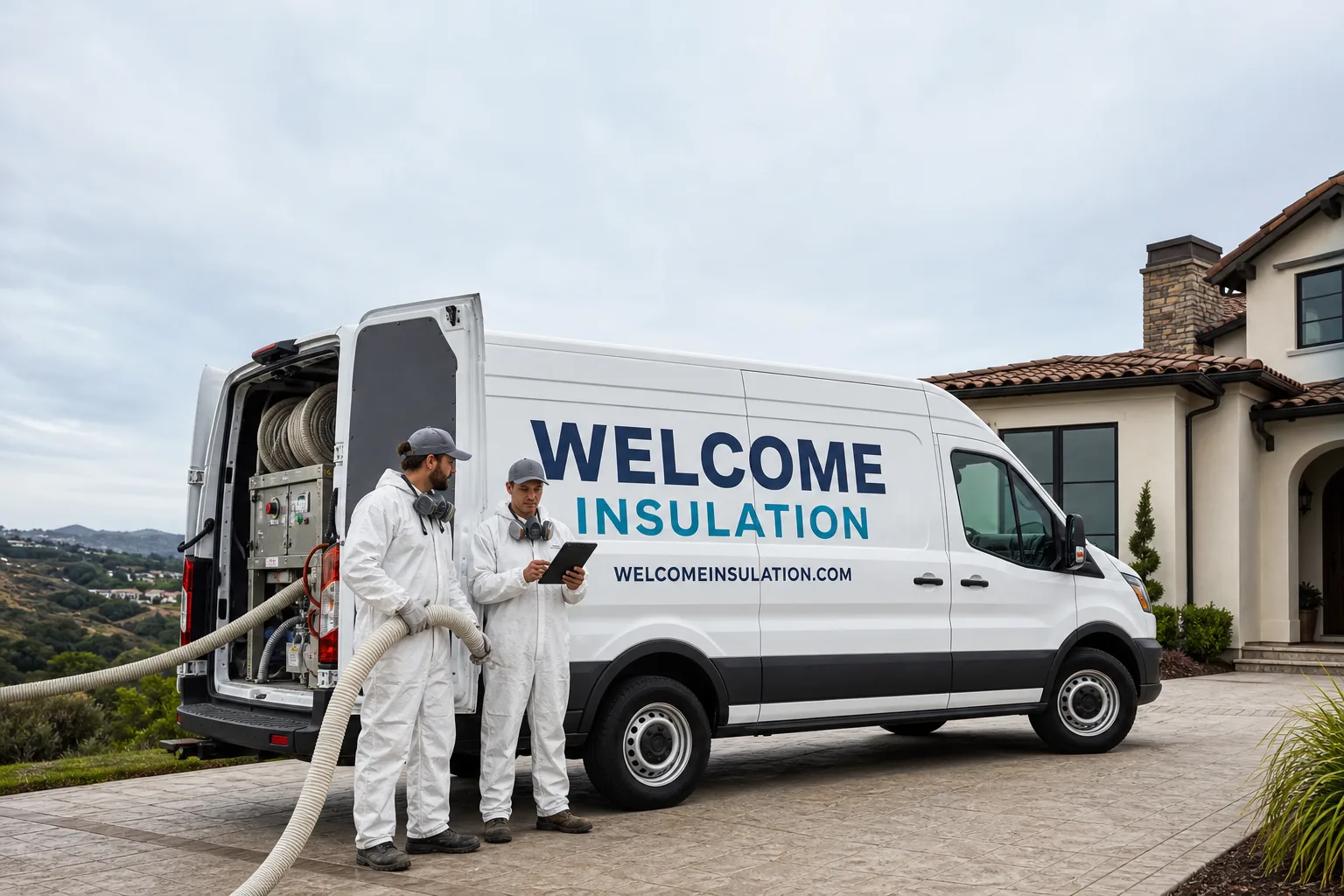
Fast, Reliable Spray Foam Insulation Across Portola Hills
Spray foam insulation in Portola Hills runs between $1.50 and $4.50 per board foot installed, with a typical rim joist job landing around $900 to $1,800 and a full attic roofline application in a 1980s tract home usually falling between $4,500 and $9,500. Homes in the 92610 zip code face a combination most coastal Orange County cities never see: intense afternoon sun on uphill slopes plus Santa Ana winds pushing dust and hot air through every unsealed seam. Our crews know exactly where those seams are because we work this community every week. If your upstairs bedrooms spike in temperature by 3 p.m., call (855) 795-2118 and we’ll give you a straight answer about what’s actually happening in your attic.
Why Welcome Insulation Is Portola Hills’s Preferred Spray Foam Insulation Company
Insulation is all we do. No plumbing calls, no HVAC side jobs, no roofing repairs between insulation installs. Every crew member trains exclusively on insulation methods, which means when we open up a Portola Hills attic, we know what we’re looking at within the first five minutes. Ruben Ochoa built Welcome Insulation around a simple idea: the right material for the right application, every time, with no guesswork.
Portola Hills homeowners call us because we understand what the Santa Ana winds do to homes on Saddleback Ranch Road, Glen Ranch Road, and the streets backing the open foothills. We also work closely with homeowners throughout Portola Hills, from the townhome clusters near Ridgeline Drive to the larger two-story tract homes up toward the toll road corridor. When we say we know your neighborhood, we mean we’ve been in attics three streets over from yours.
Our Spray Foam Insulation team stocks both Icynene and Demilec systems, so we recommend open-cell or closed-cell based on what your specific house actually needs, not what we happen to have on the truck. That matters in Portola Hills, where a south-facing vaulted ceiling needs a different approach than a north-facing attic over a garage. We’ll explain the difference in plain English and show you why we recommend one over the other.
Spray Foam Wall Insulation in Portola Hills
Spray Foam Wall Insulation in Portola Hills typically costs $2.00 to $4.00 per board foot, and most jobs on 1980s-1990s tract homes fall between $3,000 and $8,000 depending on wall depth and accessibility. Portola Hills homes built in that era often have thin R-11 fiberglass batts in exterior walls, and on the sun-facing slopes that simply isn’t enough. The afternoon radiant heat load on homes along Ridgeline and Saddleback Ranch Road pushes wall cavities past what marginal insulation can resist.
When we open a wall cavity in Portola Hills, we’re looking for two things: compressed batts that have slumped over the decades, and gaps around electrical boxes and framing where wind-driven air moves through. Spray foam addresses both in one pass. Closed-cell foam acts as an air barrier and an insulation layer simultaneously, which means those dusty top plates and unsealed penetrations get sealed rather than just covered.
Open-Cell vs. Closed-Cell for Portola Hills Walls
Open-cell foam (we install Icynene) works well for interior sound control and standard wall cavities. Closed-cell foam (Demilec) packs roughly double the R-value per inch and adds structural rigidity, which matters on exposed walls that take the full brunt of Santa Ana winds. Most Portola Hills homeowners choose closed-cell for exterior walls on the uphill side of the house and open-cell for interior partition walls.
When Portola Hills Homeowners Need Wall Spray Foam
The clearest signal is a room that won’t hold temperature. If your south-facing bedroom is 8 degrees warmer than the hallway by mid-afternoon, the wall insulation is failing, period. Another telltale sign: dust accumulating on window sills faster than the rest of the house. That’s wind-driven infiltration moving through wall cavities, and it carries fine foothill dust straight into your living space.
Rim Joist Spray Foam in Portola Hills
Rim Joist Spray Foam in Portola Hills typically runs $900 to $1,800 for a full perimeter application on a two-story tract home, and we complete most jobs in a single day. The rim joist is the band of framing where your floor meets the foundation wall, and in 1980s-1990s Portola Hills construction, it’s almost always completely uninsulated. Fiberglass stuffed into rim joist bays absorbs moisture and falls out. Spray foam stays put and seals the entire cavity.
This is one of the highest-return air sealing jobs we do in the 92610 zip code. Homes backing the open foothills get wind-driven air pushing through rim joists constantly, especially during Santa Ana events. That air brings dust, and it brings hot or cold outside temperatures directly into the floor system and up through interior walls. One of our most common findings on Saddleback Ranch Road homes: rim joists packed with decades of accumulated foothill dust sitting right on top of unsealed framing.
Why Portola Hills Homes Need Rim Joist Sealing
The tract construction boom in Portola Hills predates modern air sealing standards. Builders in the 1980s simply didn’t seal rim joists, and the result is a continuous air pathway from outside to inside. Sealing those cavities with Demilec closed-cell foam stops the air movement at the source, which means less dust in your home and lower heating and cooling loads.
What We Find In Portola Hills Crawl Spaces and Garages
Attached garages in Portola Hills tract homes share rim joist space with the living area above. That means garage heat transfers directly through the rim joist into your upstairs floors. Sealing the rim joist with spray foam cuts that heat path and keeps the garage from cooking the rooms above it, which is a complaint we hear constantly from homeowners along the toll road corridor.
Trusted Brands We Service in Portola Hills
We install Johns Manville and Knauf fiberglass products where batts make sense, and we stock Rockwool for Portola Hills homeowners who want added fire resistance and sound dampening along with thermal performance. We also handle Reflectix repair in Portola Hills when radiant barriers need attention. CertainTeed products round out our batt and blown-in options for attic applications. But the spray foam systems we trust most in this climate are Icynene for open-cell and Demilec for closed-cell. Both are widely specified brands with documented performance data, and we carry the full installation systems for both. When we recommend a material in Portola Hills, we’ll tell you exactly why that product fits your house, and we’ll name the brand so you can verify the R-value claims yourself.
Common Spray Foam Insulation Problems We See in Portola Hills Homes
- Wind-displaced batt insulation in cathedral ceilings. Homes on uphill streets backing the open foothills take direct Santa Ana wind pressure, and the original R-11 batts installed in the 1980s get compressed against the roof deck. That compression kills the R-value and leaves convection paths that pour heat into upper rooms.
- Dust-laden, unsealed top plates. The top plate where walls meet the attic floor is almost never sealed in 1980s-1990s Portola Hills construction. Wind-driven dust from the foothills accumulates along those seams, and conditioned air escapes through them year-round. Batts don’t seal these; spray foam does.
- Rim joist air bypass in attached-garage tract homes. The rim joist cavity in Portola Hills garages is a straight air channel between outside and inside. We regularly find these completely open or stuffed with deteriorated fiberglass that’s doing nothing but collecting dust.
- Failed duct sealing in original attic ductwork. Original ducts from the 1980s leak conditioned air into a 140-degree attic in summer, which masks insulation problems and drives cooling bills up. We often combine spray foam air sealing with duct sealing recommendations for Portola Hills homeowners who want the full fix.
Pricing for Spray Foam Insulation in Portola Hills, CA
Here’s what Portola Hills homeowners can expect to pay for spray foam work in the 92610 zip code: open-cell spray foam runs $1.50 to $2.50 per board foot, closed-cell runs $2.50 to $4.50 per board foot. A typical rim joist sealing job on a 1980s two-story tract home lands between $900 and $1,800. Spray foam wall insulation on a Portola Hills home usually falls between $3,000 and $8,000 depending on wall depth and access. A full roofline application, including cathedral ceiling treatment on sun-facing slopes, typically runs $4,500 to $9,500. What moves the number: whether we’re working in an unconditioned attic or a vaulted ceiling cavity, how much old insulation needs removal first, and whether your home sits on an uphill street with direct afternoon sun exposure. Every estimate is free, and we’ll walk you through the line items before you sign anything.
We Also Serve Cities Near Portola Hills
Welcome Insulation serves the entire foothill corridor, including Foothill Ranch, Lake Forest, Mission Viejo, and Trabuco Canyon. If you’re in a neighboring community and dealing with the same wind and heat issues we see in Portola Hills, give us a call. The construction patterns are similar across the foothill tract developments, and so are the fixes.
Serving Portola Hills, CA — Our Local Coverage Area
We’re based in the Portola Hills area and know this community well. Use the map below to see our service coverage — if you’re nearby, we can almost certainly help.
FAQs About Spray Foam Insulation in Portola Hills
Portola Hills sits directly against the Santa Ana Mountains along the SR-241 corridor, so homes on uphill streets backing the open foothills take direct afternoon sun and Santa Ana wind pressure that coastal Irvine never experiences. Irvine gets the marine layer; Portola Hills gets wind-driven dust and radiant heat. That combination displaces fiberglass batts and forces air through unsealed framing, which spray foam addresses because it air-seals and insulates in one application.
Call (855) 795-2118 if your upstairs rooms heat up by late afternoon, and we’ll tell you if spray foam is the right fix for your specific street and exposure.
Intact-looking batts in a Portola Hills attic are often wind-compressed against the roof deck, which means they’ve lost most of their R-value even though they look fine from below. The standard test is to check your second-floor temperature in the late afternoon during summer. If it’s 10 degrees warmer than the first floor, those batts aren’t performing. We find this pattern constantly on Saddleback Ranch Road and Ridgeline Drive homes.
We’ll inspect your attic and show you exactly what we find before recommending anything. Call (855) 795-2118 to schedule a look.
Yes, spray foam seals the top plate seam directly, which stops wind-driven dust infiltration and air leakage in one step. On a 1980s two-story tract home on Saddleback Ranch Road backing the foothills, our crew found the original R-11 batts in the vaulted ceiling cavity displaced and compressed by years of wind-driven dust, leaving the sun-facing top plates completely unsealed. After removing the failed batts, we applied Icynene spray foam to the top plates and rim joists, then re-insulated the attic to R-38. The upstairs bedrooms immediately held temperature through the afternoon sun instead of spiking.
That’s the difference between covering a problem and sealing it. We’re happy to do the same inspection on your home.
Adding more fiberglass batts to a wind-exposed vaulted ceiling is a losing game in Portola Hills. The Santa Ana winds will eventually displace the new batts the same way they displaced the originals. Closed-cell spray foam adheres to the roof deck and framing, which means it can’t shift, compress, or get pushed around by wind. It also air-seals the cavity, which fiberglass never does. For a vaulted ceiling on an uphill street, we recommend closed-cell Demilec foam almost every time.
We’ll explain the performance difference and show you the cost difference side by side. Call (855) 795-2118 and we’ll give you the numbers for your specific ceiling.
The right approach for most Portola Hills tract homes with attached garages is to seal the rim joist and shared wall top plates with closed-cell foam, then evaluate the attic roofline separately. The garage-to-house shared wall and rim joist are the biggest air bypass points, and because tract-home garages in this area are rarely insulated, they act as heat collectors in summer. Closed-cell Demilec foam on the rim joist and top plates cuts that heat transfer and blocks the dust pathway, and we can usually complete the garage-related sealing in one day.
For a full inspection and a line-item estimate, call (855) 795-2118. We’ll tell you what your garage is doing to your house and what it costs to fix.
Get a Free Spray Foam Insulation Estimate in Portola Hills
If you’re in Portola Hills and your upstairs rooms overheat every afternoon, or you’ve noticed dust accumulating along baseboards and window sills, there’s a specific reason for it, and we can find it. Welcome Insulation, led by Ruben Ochoa, serves the entire 92610 zip code with a single-trade focus: insulation is all we do. We install eight major industry brands, including Icynene and Demilec spray foam systems, and we’ll match the material to the job rather than forcing a one-size-fits-all product on your home.
Call (855) 795-2118 today for a free estimate. We’ll inspect your attic, rim joists, and wall cavities, show you what we find, and give you a clear recommendation with pricing you can understand.
Written by Ruben Ochoa, Owner at Welcome Insulation, serving Portola Hills and the surrounding foothill communities.