
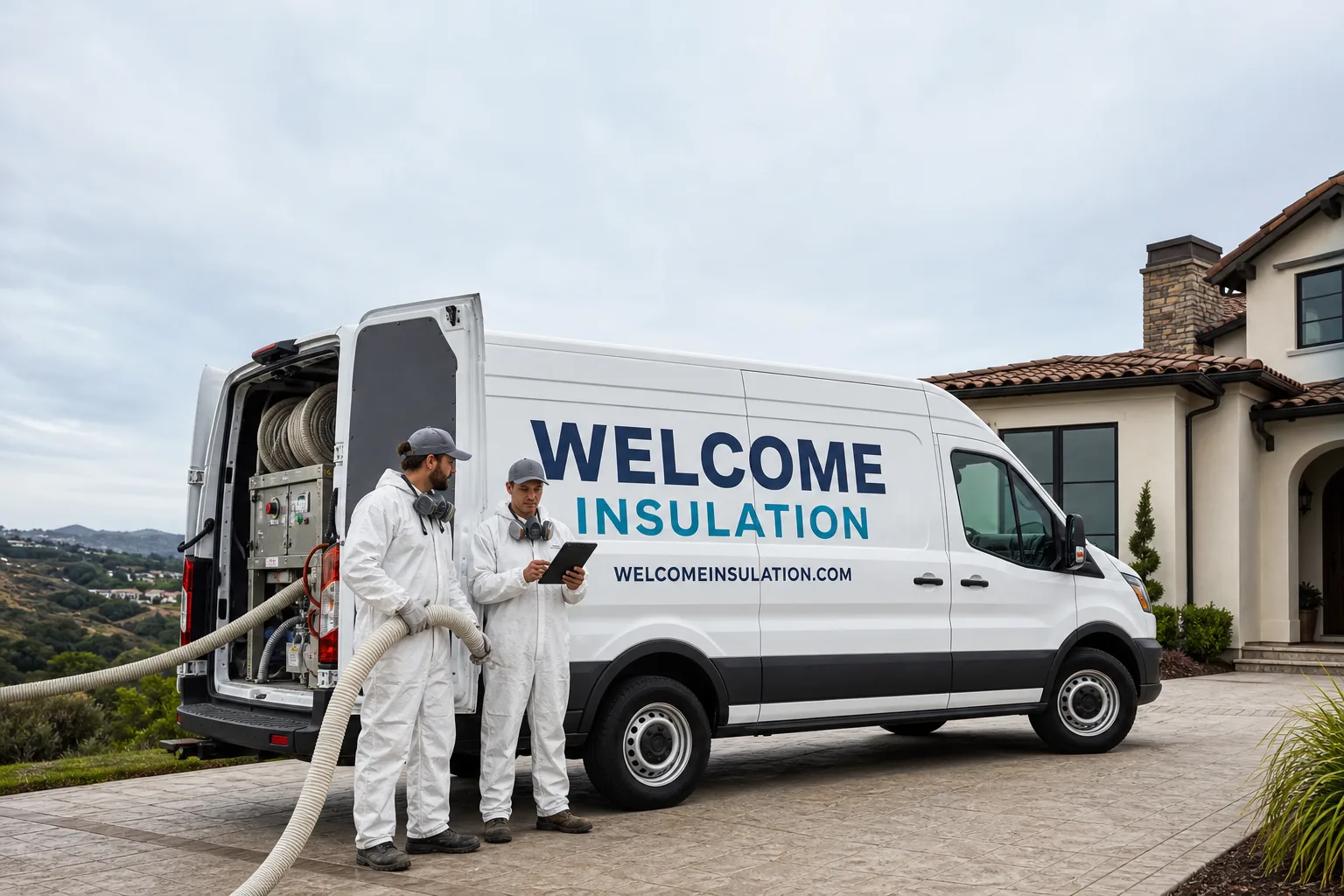
Fast, Reliable Spray Foam Insulation Across Cypress
Spray foam insulation in Cypress typically costs $2,800 – $8,500 for a full attic application, with rim joist and garage ceiling jobs running $900 – $2,400 depending on square footage. Most Cypress homes we assess fall into the retrofit category, which means we’re working around existing framing, shallow-pitch roofs, and decades-old materials rather than starting from a clean slate. We know 90630’s housing stock well: mid-century tracts off Valley View and Ball Road, apartment complexes near Lincoln Avenue, and the newer infill hugging the Los Alamitos edge all present different insulation challenges. If you’re weighing options, call (855) 795-2118 and we’ll give you a straight read on what your attic actually needs.
Why Welcome Insulation Is Cypress’s Preferred Spray Foam Insulation Company
Insulation is all we do. That single-trade focus matters in Cypress more than most places, because nearly every job here is a retrofit on a 50-to-70-year-old house with quirks you don’t learn from a manual. Our crews have worked corners of 90630 from the tract homes near Cypress College down to the streets around Oak Knoll Park, and we’ve learned that a 1963 ranch on Cerritos Avenue hides very different conditions than a 1972 two-story off Moody Street. Ruben Ochoa built Welcome Insulation around one idea: the job dictates the material, not the other way around. That’s why we stock both Icynene and Demilec systems and why we’ll tell you when closed-cell is overkill for what you’re trying to fix.
Response time to Cypress is typically same-week for estimates and 1 – 2 weeks for installs depending on scope. We carry the brands Cypress homeowners recognize: Owens Corning, Johns Manville, and Knauf among them, with documented R-value data on every product we install. You won’t get a sales script. You’ll get a conversation about what’s actually happening in your attic.
Written by Ruben Ochoa, Owner at Welcome Insulation, serving Cypress since our first 90630 retrofit.
Closed Cell Spray Foam Insulation in Cypress
Closed Cell Spray Foam Insulation is the answer for most Cypress attics with shallow-pitch roofs and settled original batts, and it usually runs $3,500 – $8,500 for a standard single-story tract home when applied at the ceiling plane. Because so many 90630 houses were built with only 3 – 4 inches of fiberglass that’s compressed and sagging, closed-cell does double duty here: it air-seals ceiling penetrations while adding R-value in a single pass. The foam expands to roughly 2 inches and hardens into a rigid, moisture-resistant barrier that also stiffens the roof assembly, which older Cypress framing often benefits from.
Air-Sealing Plus Insulation in One Pass
In Cypress’s original tract stock, we rarely see attics that don’t leak air around recessed can housings, top plates, and plumbing stacks. Closed-cell foam seals those gaps as it’s applied, addressing the bypass air that was carrying hot, humid summer air straight past the old batts. For houses off the Los Alamitos side of 90630, that sealing function matters even more because coastal moisture finds every unsealed seam.
When Closed-Cell Earns Its Cost
Closed-cell costs more per board foot than open-cell, yes. But in a shallow attic where you can’t add much depth, its R-6.5-to-R-7 per inch means you get real insulation value without piling material higher than your roof structure can handle. If your Cypress attic has less than 18 inches of headroom at the eaves, closed-cell is usually the right call.
Open Cell Spray Foam in Cypress
Open Cell Spray Foam in Cypress is a sensible option for attic roof deck applications and runs roughly $2,800 – $5,500 depending on attic square footage. This foam expands dramatically, filling irregular rafter bays and odd corners that plague 1950s-1970s framing better than rigid or batt products can. It’s lighter than closed-cell and has a lower cost per R-value, which appeals to Cypress homeowners who want meaningful improvement without the premium price of a full closed-cell job. The trade-off is that open-cell absorbs moisture if directly exposed to bulk water, so proper ventilation and dry substrate preparation matter.
Roof Deck Applications
If you’re converting a Cypress garage or finishing an attic space, open-cell on the roof deck keeps the thermal boundary at the roofline, not the ceiling. That’s the standard approach for vaulted or cathedralized attics, and it handles Cypress’s warm summer afternoons well when paired with adequate roof venting.
Knee Wall and Can Surround Work
On Cypress homes with bedroom knee walls facing a unconditioned attic, open-cell fills those narrow, awkward cavities quickly. We often pair it with closed-cell at can surrounds and other penetrations where a more rigid seal is needed, giving you the best of both materials where each one fits.
Trusted Brands We Service in Cypress
We install Spray Foam Insulation using both Icynene and Demilec systems, two of the most widely specified spray foam brands available. For Cypress homeowners who prefer mineral wool’s fire resistance and sound control, we install Rockwool. And when blown-in top-up is the better option, we carry Owens Corning and Johns Manville fiberglass along with GreenFiber cellulose. The point is choice with a reason behind it: we recommend a brand because of what it does for your specific Cypress house, not because it’s what we have on the truck. Ask us why we recommended open-cell over closed-cell, or Rockwool over foam, and we’ll explain the trade-offs in plain terms.
Common Spray Foam Insulation Problems We See in Cypress Homes
- Settled original batts under shallow roofs. Most 1950s-1970s attics in 90630 have only 3 – 4 inches of compressed fiberglass left, far below today’s Title 24 guidance. Spray foam applied over those batts without removal or air-sealing just buries the problem.
- Unsealed ceiling penetrations. Recessed can housings, top plates, and wire drops in old Cypress tract homes leak air constantly. Foam that doesn’t seal these first lets conditioned air escape all year.
- Condensation at knee-wall junctions. Warm, humid Cypress summers push moisture into wall assemblies never designed for vapor barriers. Improperly foamed cold surfaces at these junctions can sweat, so substrate prep and material choice matter.
- Corroded fasteners near the coast. Homes along the Los Alamitos/Seal Beach edge of 90630 see salt air accelerate rust on exposed garage and attic hardware. We use corrosion-conscious fasteners and clean prep so foam bonds to sound surfaces.
Pricing for Spray Foam Insulation in Cypress, CA
A full attic closed-cell application in Cypress typically lands between $3,500 and $8,500 for a single-story tract home, while rim joist and garage ceiling jobs run $900 – $2,400. Open-cell roof deck work usually falls between $2,800 and $5,500 depending on square footage and access. What moves your price: attic headroom, how much old insulation must be removed or covered, how many penetrations need sealing, and whether we’re working around stored belongings. For homes along the coastal edge, corrosion prep adds modest material cost. Estimates are free, and we give you a written number before any work begins. Call (855) 795-2118 to schedule yours.
We Also Serve Cities Near Cypress
Welcome Insulation handles Spray Foam Insulation in Cypress and the surrounding communities, including La Palma, Los Alamitos, Rossmoor, and Hawaiian Gardens. The housing stock varies across these cities, from Rossmoor’s larger custom ranches to the denser tracts of Hawaiian Gardens, but the retrofit challenges are often similar: aging attics, shallow roofs, rising energy costs. Wherever you are, insulation is all we do.
Serving Cypress, CA — Our Local Coverage Area
We’re based in the Cypress area and know this community well. Use the map below to see our service coverage — if you’re nearby, we can almost certainly help.
FAQs About Spray Foam Insulation in Cypress
Cypress attics under shallow-pitch roofs frequently have ceiling penetrations around can housings, top plates, and plumbing stacks that were never sealed when the house was built in the 1950s-1970s. Foam applied without air-sealing first lets humid coastal air bypass the insulation entirely, so we almost always recommend sealing before or during foam application. Call (855) 795-2118 and we’ll tell you what your attic actually needs after we walk it.
Closed-cell usually wins in shallow Cypress attics because it delivers R-6.5 to R-7 per inch, meaning you get meaningful insulation without adding material depth your low roof can’t accommodate. Open-cell makes sense when you’re foaming a roof deck or filling awkward cavities where closed-cell’s cost outweighs its benefit. Ruben Ochoa’s crew will show you the numbers for your specific roof before you commit.
Not always, but they often should be removed or carefully assessed first. Original batts in 90630 attics are commonly settled to 3 – 4 inches, and spraying foam over them without addressing compress or contamination can trap moisture and reduce bond. We’ll look at the condition of your existing insulation before recommending removal or a hybrid approach. Free attic assessments are part of every Cypress estimate.
Yes, especially closed-cell foam, which acts as both insulation and an air and moisture retarder. In Cypress’s older wall assemblies with no vapor barrier, closed-cell applied correctly can reduce humid air infiltration that drives summer discomfort. The key is proper substrate prep and choosing the right foam for each cavity, which is exactly the kind of material-matching call our installers make every day.
Yes, salt air from the coast accelerates rust on exposed fasteners, can housings, and any metal in garages and attics close to the Los Alamitos/Seal Beach line. We use corrosion-resistant fasteners and clean, dry substrate prep on those homes so the foam bonds to sound material and the assembly lasts. If you’re within a few blocks of the coastal edge, mention it when you call – it changes our prep checklist. Call (855) 795-2118 for a free estimate.
Written by Ruben Ochoa, Owner at Welcome Insulation, serving Cypress, CA and surrounding communities.