
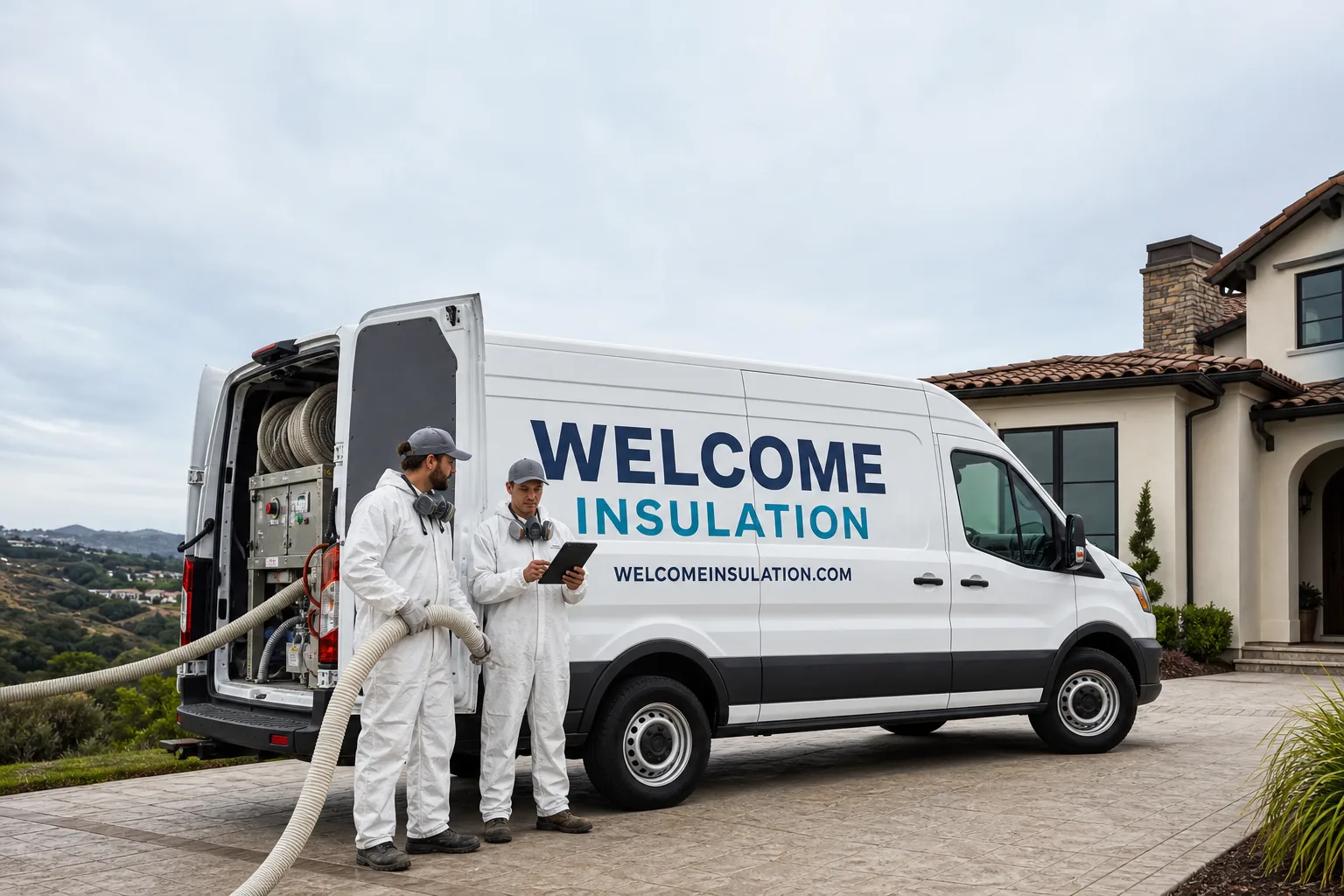
Spray Foam Insulation in Anaheim: Cuts Cooling Costs in Mid-Century Homes
Spray foam insulation in Anaheim typically costs $2.20 to $4.10 per board foot for open-cell and $3.40 to $6.20 per board foot for closed-cell, putting a full attic retrofit on a 1950s ranch in the 92805 tract at roughly $6,800 to $13,500. The real value here isn’t just the R-value. It’s the air-sealing that stops Anaheim’s July-through-September attic heat from pushing into your living space. Welcome Insulation installs Spray Foam Insulation with Icynene and Demilec systems, and we’ve spent enough hours in Anaheim attics to know exactly what makes this city different from the beach towns 20 minutes west.
Fast, Reliable Spray Foam Insulation Across Anaheim
If you live in Anaheim and your upstairs rooms turn into an oven by 3 p.m. between July and September, you’re dealing with what we call the inland-transition heat load. Your attic is absorbing direct sun all afternoon and radiating that heat straight through your ceiling. We respond to Anaheim calls from our base in San Joaquin Hills, usually within one to two days for an estimate, and we cover every ZIP from 92801 through 92808. Call (855) 795-2118 and we’ll schedule a walkthrough of your attic, measure your current insulation depth, and give you a straight answer about whether spray foam is the right fix or whether a different material makes more sense for your house.
Why Welcome Insulation Is Anaheim’s Preferred Spray Foam Insulation Company
Rubén Ochoa started Welcome Insulation as a single-trade shop because one trade done deeply beats five trades done shallowly. Insulation is all we do. Our crews are in Anaheim attics week after week, and we know the housing stock: single-story ranches off Lincoln and Euclid in 92805, two-story 1970s suburbans in 92804, and the newer hillside builds up in Anaheim Hills’ 92807 and 92808. Homeowners here tell us the same two things after we finish: their air conditioner finally cycles off during the day, and their upstairs rooms stopped feeling five degrees warmer than downstairs. We don’t carry a review count we can’t verify, but we do carry a local reputation built on showing up when we say we will and telling homeowners when spray foam isn’t the right product for their problem.
Spray Foam Insulation Contractors in Anaheim
Spray Foam Insulation Contractors in Anaheim need to understand something that a generic foam crew misses: in this city, the bond between foam and framing is the whole job. We see closed-cell foam sprayed onto rafter faces still coated with decades of blown-in freeway debris in 92801 and 92805 attics, and within a season the foam delaminates and sags, so the seal fails and the homeowner paid for insulation that’s now hanging off the roof. Our approach is to abrade and prime before we spray. It’s slower. It’s also the only way the foam adheres on a 1950s ranch that’s spent 60 years collecting dust from the 5 and 91 freeways.
Surface Prep That Makes the Seal Last
Before we spray anything, we run a HEPA vac across every rafter face and ridge board. Then we abrade the sheathing with a scrubber to cut through the film of exhaust residue and dust that sits on old Anaheim framing. The primer goes on next, and only then does the Icynene or Demilec foam go in. On homes where we’ve skipped prep recommendations to save a few hundred dollars, the result is a foam seal that fails within one cooling season. We won’t do that here. The houses in 92801 and 92805 simply have too much airborne debris embedded in the attic framing.
Air-Sealing Before R-Value
A lot of Anaheim homeowners ask us to match a quote from a company that only talks about R-value. R-value matters, but in a mid-century tract house with a low-pitch roof, the top plates and wire penetrations leak air straight into the attic. We seal those first. Then the foam goes in as a continuous thermal and air barrier. Skipping the air-sealing step gets you an attic that still draws hot, dust-laden air up from the walls, and your living space never cools down the way it should.
Spray Foam Attic Insulation in Anaheim
Spray Foam Attic Insulation in Anaheim works differently than it does in Huntington Beach or Costa Mesa because those beach cities get the marine layer’s moderating effect. Anaheim sits inland in Orange County’s coastal-inland transition, so afternoon attic temps here spiked into the 130s and 140s last August while beach attics sat 15 to 20 degrees cooler. That means the air-sealing function of spray foam does more cooling-season work here than the foam’s R-value alone. A closed-cell Icynene roof-deck application on a 92805 ranch seals the assembly and puts a continuous thermal break at the roofline, which is where Anaheim’s summer heat actually enters your house.
Roof Deck Applications for Low-Pitch Ranches
The 1950s and 60s single-story homes in 92801, 92802, and 92805 have low-pitch roofs, which means the attic is tight and the roofline is close to the ceiling below it. Spraying foam against the roof deck converts the attic from a vented hotbox into a semi-conditioned space, and that’s the single biggest improvement you can make to a mid-century Anaheim ranch. We’ve measured ceiling-surface temperatures in these homes before and after a roof-deck application, and the drop in the upstairs bedrooms is the part homeowners notice first.
Radiant-Barrier Topcoat for Cooling-Season Performance
In Anaheim, we sometimes recommend a radiant-barrier topcoat over the foam on roof-deck applications. The foam does the air-sealing and the thermal resistance, but the radiant barrier reflects solar gain off the roof sheathing, which keeps even more heat out of the attic in July through September. For a home in 92807 or 92808 with a dark composite shingle roof and direct afternoon sun, that combination does more to cut cooling costs than adding another inch of foam. It’s a material-matching decision, not an upsell.
Trusted Brands We Service in Anaheim
For Anaheim attic retrofits, we install Icynene and Demilec spray foam systems because both manufacturers publish documented R-value performance data and have field-tested open-cell and closed-cell formulas. We also stock Johns Manville and Rockwool products for homeowners who decide spray foam isn’t the right fit after we walk their attic. The brand decision comes after we look at your roof pitch, your framing condition, and your cooling-season goals. We won’t push Demilec on a house that needs Rockwool’s fire-resistance rating, and we’ll tell you exactly why we recommended one material over the other. Ask us that question on the estimate call.
Common Spray Foam Insulation Problems We See in Anaheim Homes
- Foam delaminating from dusty rafters. In the older 92801 and 92805 tracts, closed-cell foam sprayed onto rafter faces coated with decades of freeway debris from the 5 and 91 loses its bond and sags within a season. We abrade and prime every rafter face before spraying so the foam actually sticks to the framing.
- Heat trapped between settled batts and new foam. Homes built in the 1950s and 60s often still have original batts that have compressed to half their original depth. Spraying foam over those batts without removing them first traps heat between the layers, so July – September attic temps still spike and the living space below never cools.
- Unsealed top plates leaking freeway air and dust. Post-war tract framing has gaps where the walls meet the attic. If we don’t seal the top plates and wire penetrations before spraying, air bypasses the foam entirely and the upgrade underperforms its rated R-value. This is the step budget crews skip, and it’s the step that makes the upgrade work in Anaheim.
- Foam applied without a radiant barrier in west-facing Anaheim Hills homes. Homes in 92807 and 92808 on hillside lots get hours of direct afternoon sun on their west faces. Closed-cell foam alone reduces conduction, but adding a radiant barrier to the roof deck cuts the solar gain that makes those attics unbearable in September. It’s a cooling-season decision, and it matters more here than it would in a beach city.
Pricing for Spray Foam Insulation in Anaheim, CA
Here’s what Anaheim homeowners should expect to pay, based on the jobs we’ve priced in the 92801 through 92808 areas over the past two years:
- Open-cell spray foam attic floor or roof deck: $2.20 to $3.60 per board foot
- Closed-cell spray foam roof deck (Icynene or Demilec): $3.60 to $5.40 per board foot
- Closed-cell with radiant-barrier topcoat for Anaheim Hills west-facing roofs: $4.80 to $6.20 per board foot
- Full attic retrofit on a 1,000 to 1,400 sq ft 1950s ranch in 92805: $6,800 to $13,500
- Abrade-and-prime surface prep for freeway-dust attics in 92801 and 92805: $400 to $900 depending on attic size
What moves the number: attic square footage, roof pitch, existing insulation that needs removal, and whether we’re doing air-sealing as part of the job. We don’t charge for the estimate, and we’ll give you a written line-item quote before you commit to anything. Call (855) 795-2118 and we’ll schedule the walkthrough.
We Also Serve Cities Near Anaheim
Our crews cover the neighborhoods around Anaheim too. We’re in Fullerton, Placentia, Orange, and Villa Park regularly, and we know the housing stock in each of those cities well enough to adapt our prep and spray approach to local conditions. If you’re anywhere in the Spray Foam Insulation in Anaheim area, call (855) 795-2118 and we’ll get you on the schedule.
Serving Anaheim, CA — Our Local Coverage Area
We’re based in the Anaheim area and know this community well. Use the map below to see our service coverage — if you’re nearby, we can almost certainly help.
FAQs About Spray Foam Insulation in Anaheim
Anaheim doesn’t get the marine layer that moderates temperatures in Huntington Beach and Costa Mesa, so attic temps here run 15 to 20 degrees hotter on July through September afternoons. That means spray foam’s air-sealing function does more of the heavy lifting in Anaheim, because stopping hot attic air from infiltrating your living space matters more when the attic itself is hitting 140 degrees. In beach cities, the foam’s R-value is the primary benefit. In Anaheim, it’s the seal that makes the difference, which is why we pair closed-cell foam with a radiant-barrier topcoat on many homes here. Call (855) 795-2118 if you want us to walk your specific attic and explain what we’d recommend for your roofline.
In the older 92801 and 92805 tracts, our crews routinely find attic framing dusted with decades of blown-in debris from the nearby 5 and 91 freeways, and closed-cell foam won’t bond to that surface. We abrasive-clean the rafter faces and sheathing, then prime them before spraying Icynene or Demilec. Foam that skips this step delaminates and sags within one cooling season, so the prep work is what actually makes the seal last. Call (855) 795-2118 for an estimate, and ask us to show you the prep step we’re quoting.
No, and we’ll tell you that on the phone before we even see the attic. The original batts in 1950s and 60s Anaheim homes have usually settled to half their original depth and are coated in fine dust. Spraying foam over them traps heat between the batt layer and the foam layer, so your attic still bakes in July and the upgrade underperforms its rating. We remove the settled batts, air-seal the top plates and penetrations, then spray against the roof deck. It’s the only sequence that delivers the cooling-season performance Anaheim homeowners are actually paying for. Call (855) 795-2118 and we’ll walk you through the full scope.
Anaheim’s mild winter is exactly why spray foam still makes sense here, because your problem season is summer, not winter. Batts slow conduction but they don’t stop the air movement that pulls hot attic air into your living space through top plates and wire holes. In a mid-century tract home, spray foam seals those leaks and puts a continuous thermal break at the roofline, which is what actually cuts your August cooling bill. We stock Rockwool and Johns Manville batts too, so if your attic genuinely doesn’t need foam, we’ll tell you that and install batts instead. Call (855) 795-2118 for an honest recommendation.
We install Icynene and Demilec spray foam systems, and we choose between them based on the specific performance need of each Anaheim home. On a 1950s ranch in 92805 with a low-pitch roof and freeway-dust framing, we typically use Icynene closed-cell against the roof deck after abrading and priming the sheathing. On a 1970s two-story in 92804 where the attic is tight and access is limited, Demilec’s closed-cell formula is often the better fit. Open-cell goes in where the attic is vented and we’re sealing the floor rather than the roofline. Call (855) 795-2118 and we’ll explain which brand we’d specify for your house and why.
On a 1950s single-story ranch in the 92805 tract off Lincoln, our crew opened the low-pitch attic and found original batts settled to half depth under a layer of freeway grit, with the ridge rafter faces too dusty for foam to bond. We hand-scrubbed and primed the sheathing, then sprayed Icynene closed-cell against the roof deck to seal the assembly and cut the afternoon heat load. That’s the job we do in Anaheim every week, and it’s why we treat surface prep as the foundation of every spray foam retrofit here.
For a free estimate on spray foam insulation in your Anaheim home, call (855) 795-2118. We’ll walk your attic, measure what’s there, and give you a written quote with the material and method we’d actually specify for your house, not a one-size-fits-all number.
Written by Ruben Ochoa, Owner at Welcome Insulation, serving Anaheim and Orange County with spray foam, attic, and blown-in insulation.